Marjuana Bush Williams, a prominent attorney specializing in real estate and business law, was honored as the “Woman of the Year” during the Martin Luther King Jr. Support Group of Southeast Texas’s 40th Annual ‘I Have A Dream’ brunch on January 19, 2026. The event took place at the Bob Bowers Civic Center in Port Arthur, Texas, where Williams emphasized that her recognition transcends personal achievement.
“It wasn’t about me,” Williams stated. “It was about every young girl who’s ever been told she can’t. If God is for you, no one can be against you—and that truth carried me here.” Her journey from a childhood fascination with the law to becoming a distinguished attorney is a testament to her resilience and determination.
From Dreams to Reality
Williams graduated at the top of her class from Abraham Lincoln High School, a pivotal moment that solidified her commitment to a legal career. Her interest in law was sparked during childhood, watching reruns of *Law & Order* with her grandmother. She earned a full academic scholarship to Texas Southern University and later attended South Texas College of Law in Houston.
Life progressed rapidly for Williams; she married and welcomed her first child just one week before her final year of law school. After a brief hiatus, she returned to her studies and graduated on time. In 2008, amid a national recession, she joined a small law firm in Beaumont, Texas. Although job opportunities were limited, she viewed her experience as essential preparation for future challenges.
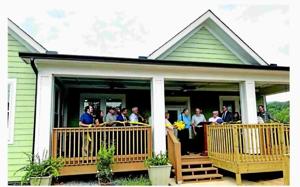
Williams made history as the first Black attorney at Bell and Tucker, a firm with a century-long legacy. “It wasn’t always comfortable,” she recalled, “But it was necessary.” Alongside her husband, she developed a construction company that has since built nearly 40 rental properties in the area, with plans for more on secured land.
A Multifaceted Career
In 2018, Williams established her own firm, MarJuana Bush Williams, PLLC, focusing on real estate law. Her double board certification in residential and commercial real estate complements her lifelong passion for development. She also serves on multiple state and national boards, further expanding her professional influence.
Her entrepreneurial spirit led her to become a franchisee of Toasted Yolk Cafe and Jeremiah’s Italian Ice, both of which she has established in Mont Belvieu, Texas. Despite her achievements, Williams prioritizes purpose over titles. “When people ask me why I do what I do, the answer is simple,” she explained. “I’m going to live a life that makes people want to know my God.”
During her acceptance speech, Williams emphasized themes of faith, resilience, and responsibility, stating, “When they called my name, I didn’t just feel honored. I felt seen—not for the titles, not for the businesses, but for the belief that God opens doors no man can shut.”
Williams is deeply committed to her community, focusing on education. She frequently speaks to students in Port Arthur and Nederland, advocating for self-definition and resilience against societal pressures. “Don’t let other people decide who you are,” she urged. “If God is for you, no one can be against you. I hope when the kids in our city read this, they see that their dreams matter.”
She often employs vision boards as a teaching tool, encouraging students to visualize their futures and resist external limitations. This practice, which she embraced early in life, enabled her to manifest her dreams into reality.
At home, she raises five children, instilling in them the same values of discipline, identity, and accountability. “People are always watching,” she reminds them, “Even when you think they aren’t.”
Williams acknowledges the significant challenges of racism and being underestimated but refuses to let these experiences define her. “Even when people decided what I couldn’t be, God had already decided what I was,” she stated. “There comes a point where you stop trying to prove yourself to people and start standing on what you know God called you to do.”
Her narrative is not solely about personal success but about aligning with a greater purpose. It challenges readers to consider the possibilities that arise when they reject the limits placed upon them. If the constraints we accept are not real, who might we become by embracing our true potential?