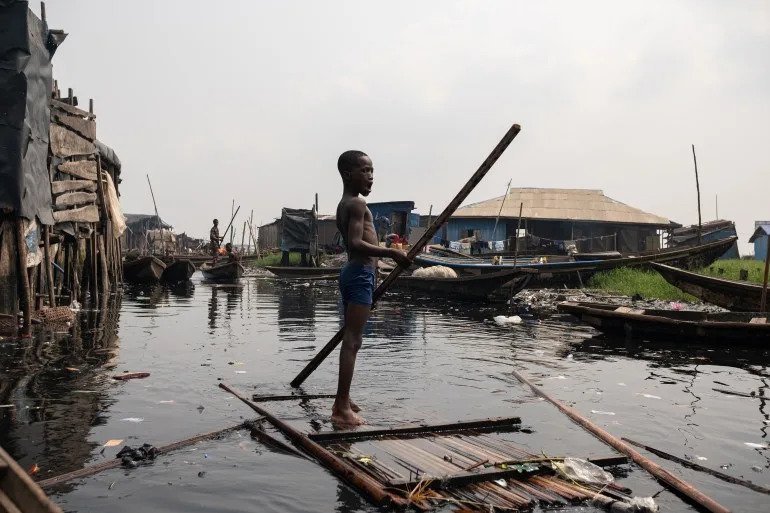
Residents of the Makoko floating settlement in Lagos, Nigeria, are grappling with the aftermath of a forced eviction campaign that has left thousands homeless. The demolition operation, initiated by the Lagos State government in late December 2023, was ostensibly aimed at clearing areas near high-tension power lines. However, community leaders and nonprofit organizations have accused the government of exceeding the stated boundaries and demolishing homes well beyond the 100-metre mark.
On a January afternoon, local resident Tunde Agando witnessed the destruction of his family home while returning from the market. An excavator, accompanied by police, razed the structure where he lived with 15 relatives, along with their possessions. Agando reflected on the experience, stating, “We now sleep on mats under a shed outside our pastor’s house, while we try to look for our lost belongings and figure out what to do next.” His barber shop was also demolished that day, compounding his family’s distress.
The demolitions have affected not only the homes but also the livelihoods of many residents. According to reports, more than 12 people, including infants, have died as a consequence of the demolitions. As community members scrambled to salvage their belongings, the surrounding waters were filled with canoes carrying essential items to safety.
Historical Context and Community Resilience
Makoko, often referred to as the “Venice of Africa,” has a rich history as a fishing village dating back to the 19th century. Built on stilts, it is home to approximately 200,000 people who depend on fishing and local markets for their livelihoods. Despite the picturesque setting, the community struggles with poverty and a lack of infrastructure.
Many residents, like Phoebe Ekpoesi, have found themselves displaced and without resources. “This Makoko is everything we have,” she lamented after losing her home and business. Observers note that the demolitions exacerbate the hardships faced by already vulnerable populations, including women and individuals with disabilities.
Victoria Ibezim-Ohaeri, the executive director of Spaces for Change, emphasized the broader implications of the demolitions, stating, “There is disruption of their children’s education, and people are becoming increasingly homeless.” The loss of communal land and a sense of belonging is another critical concern, as communities are uprooted without adequate compensation or resettlement plans.
Government Actions and Community Response
The Lagos State government has defended its actions, arguing that the demolitions are necessary for public safety. Governor Babajide Sanwo-Olu stated, “What we are doing is not demolishing the whole of Makoko. We are clearing areas to ensure they do not encroach on the Third Mainland Bridge and to keep residents away from high-tension lines.” Despite this claim, activists argue that the government’s motives may be tied to the lucrative property developments in the area.
Reports indicate that the government has plans for a private development project in Makoko, which raises suspicions among residents and advocates. Deji Akinpelu, co-founder of Rethinking Cities, expressed concern that the demolitions reflect a historical pattern in Lagos where informal settlements are cleared for upscale developments.
The situation escalated when community members attempted to protest the evictions on January 29, 2024, demanding a meeting with the governor. Police responded with tear gas, dispersing the crowd and highlighting the tensions surrounding the demolitions.
While the Lagos State House of Assembly recently proposed a compromise that includes a water-city regeneration project, many residents remain uncertain about their future. Agando and his family, now living in a temporary shelter, are considering relocating to Ikorodu, northeast of Lagos, as they seek to rebuild their lives.
As the situation unfolds, the residents of Makoko are left navigating a precarious existence, with their homes and livelihoods stripped away. The impact of this crisis raises critical questions about urban governance, community rights, and the balance between development and the welfare of vulnerable populations.