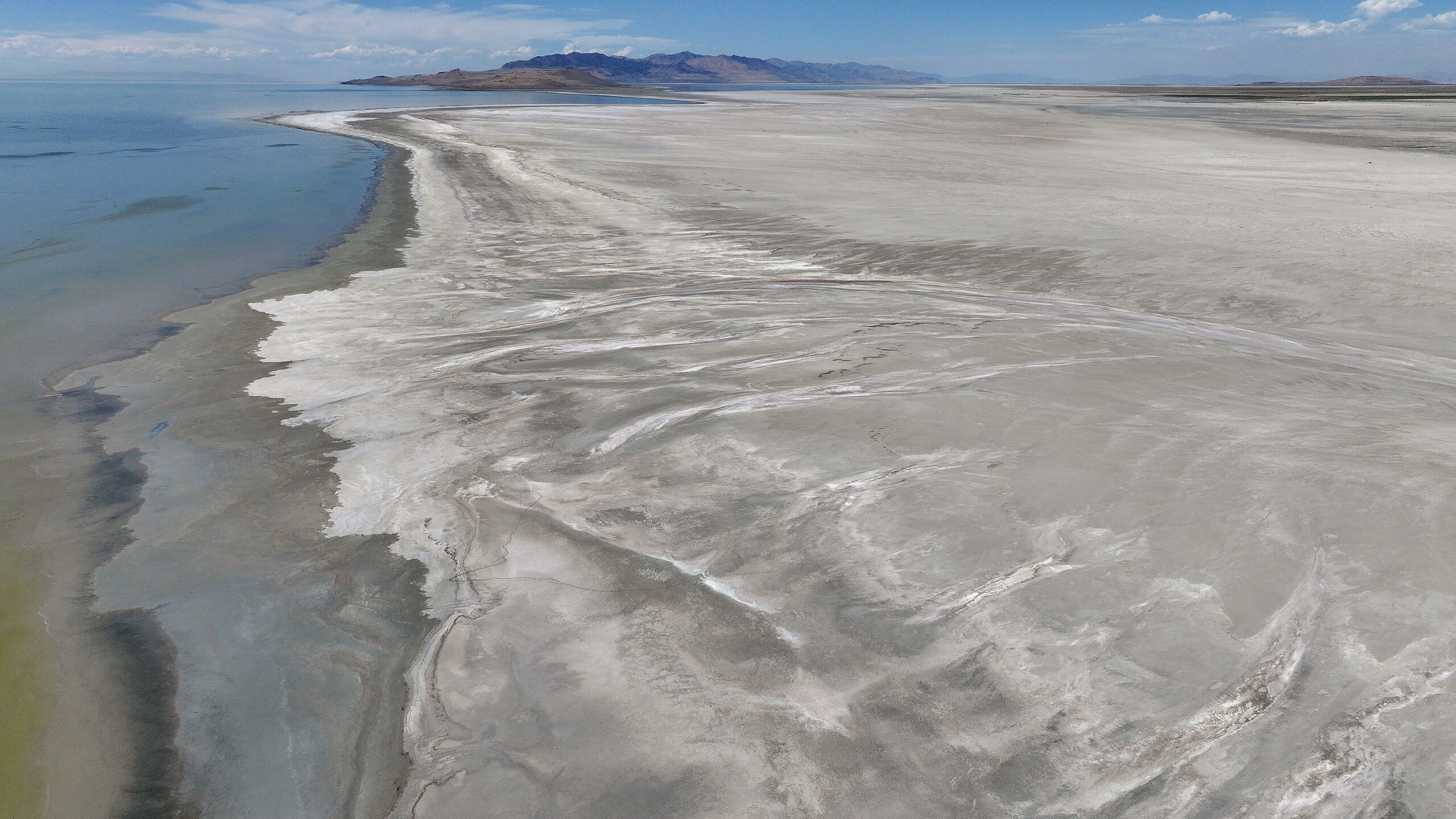
The Great Salt Lake, the largest saltwater lake in the Western Hemisphere, faces significant challenges as its shores recede. Utah Governor Spencer Cox is committed to reversing this trend, promising that by the time the 2034 Winter Olympic Games arrive, the lake will be “full.” This ambitious goal will require substantial efforts, as the lake’s area has decreased from approximately 2,300 square miles in 1986 to about 1,700 square miles today.
To improve the lake’s status, which has been classified as experiencing “serious adverse effects,” the state must add an estimated 261 billion gallons (or 800,000 acre-feet) of water. The current crisis is largely attributed to municipal and industrial water use, which diverts water from rivers and reservoirs before it can reach the lake. Contributing factors include rising average temperatures, which accelerate evaporation, and insufficient rainfall in the region.
Utah’s legislative efforts reflect a growing concern for the lake’s future. Lawmakers have dedicated significant time to discussing the issue, with Senate President Stuart Adams noting it has become a priority in recent sessions. The 2026 legislative session features several bills aimed at addressing the lake’s shrinkage:
One bill, sponsored by Rep. Jill Koford (R-Ogden), mandates that data centers disclose their water usage or face a daily penalty of $10,000 until compliance. Another measure, also by Koford, simplifies the process for farmers to temporarily redirect their water rights to storage in reservoirs or for instream flow. Additionally, Rep. Doug Owens (D-Millcreek) has introduced a bill that would increase the cost of excess water used for lawn care, aiming to encourage conservation.
Another significant proposal, spearheaded by Sen. Nate Blouin (D-Salt Lake City), seeks to reallocate $200 million from the Bear River Development funding to support the Great Salt Lake. This initiative is part of a broader strategy initiated in the early 1990s to secure municipal water for the Wasatch Front.
Amid these legislative efforts, Utah may also acquire the water rights of US Magnesium, which recently declared bankruptcy. The state won a bid for the mining company’s land and water rights for $30 million, which included access to nearly 17 billion gallons of water. This acquisition is seen as a vital step to halt the lake’s decline. Historically, US Magnesium has been a significant contributor to pollution in the Salt Lake Valley, accounting for up to 25% of fine particulate pollutants in the area.
There are growing concerns about the health risks posed by the exposed lakebed, as contaminants such as arsenic and mercury could affect local communities. While experts, including Kevin Perry, a professor of atmospheric sciences at the University of Utah, have found no direct evidence linking arsenic levels in the lake to increased concentrations in surrounding areas, there is a consensus on the need for improved monitoring. Currently, only six dust monitors operate in northern Utah, mostly in areas less likely to be affected by dust from the lakebed.
In response to these challenges, Utah’s Legislature approved a one-time payment of $12 million and an ongoing annual contribution of $5 million to support cloud seeding initiatives. This weather modification technique, which involves dispersing substances into clouds to enhance precipitation, has reportedly increased rainfall by 5-15% in targeted areas. The program, which has transitioned to using remote generators at higher elevations, is seen as a promising method to boost water supplies.
During discussions on these initiatives, Joel Ferry, executive director of Utah’s Department of Natural Resources, expressed optimism about the cloud seeding program’s effectiveness. He emphasized the importance of balancing conservation efforts with innovative approaches to increase water availability.
As debates continue over the environmental and health impacts of the lake’s shrinkage, the Salt Lake Valley experiences a temperature inversion during the winter months. While this phenomenon traps pollutants in the air, experts clarify that it does not lead to significant dust production, as the region typically lacks wind during these periods.
The multifaceted approach undertaken by Utah’s government represents a concerted effort to address the pressing issue of the Great Salt Lake’s decline. With legislative measures, potential water rights acquisitions, and innovative weather modification techniques, officials are working diligently to secure the future of this vital natural resource.