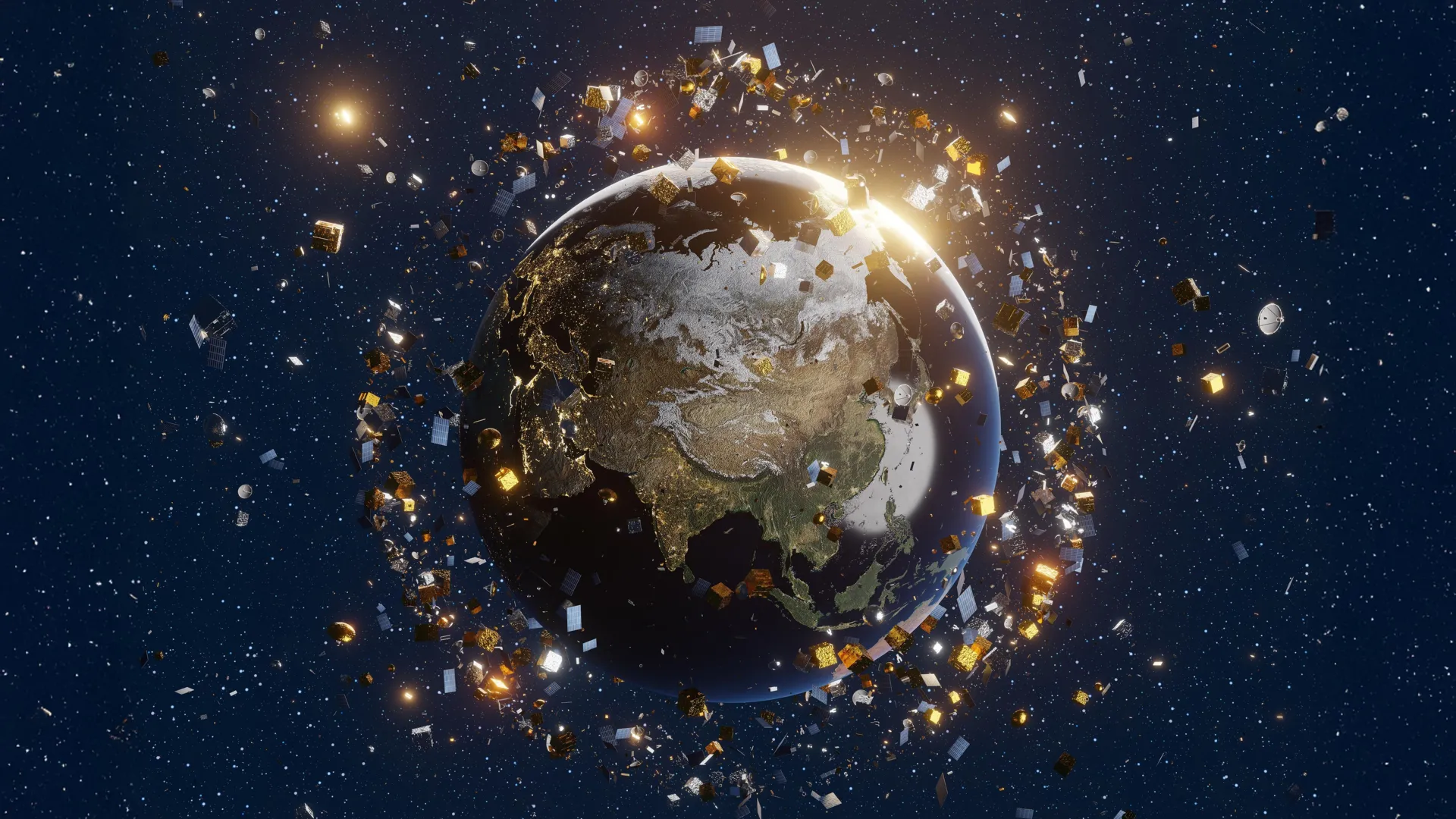
Low-Earth orbit is at a significant risk of disaster, with new calculations indicating that a catastrophic chain reaction could begin in as little as 2.8 days. This alarming forecast underscores the increasing vulnerability of satellite networks, particularly in light of potential solar storms that could disrupt navigation and communication systems.
Research conducted by Sarah Thiele, formerly a PhD student at the University of British Columbia and currently a researcher at Princeton University, highlights the precarious nature of today’s satellite constellations. In a recent paper published on arXiv, Thiele and her colleagues argue that the current architecture of massive satellite networks resembles a “House of Cards,” precariously balanced and prone to collapse under stress.
The study reveals that satellites in Low Earth Orbit (LEO) frequently approach one another at dangerously close distances. A “close approach,” defined as two satellites coming within less than 1 km of each other, occurs approximately once every 22 seconds across all LEO mega constellations. Within the Starlink network alone, these encounters take place every 11 minutes. To mitigate collision risks, each Starlink satellite executes an average of 41 course corrections annually.
Given the frequency of these maneuvers, one might assume that the system is functioning effectively. However, engineers acknowledge that failures often arise from unexpected scenarios, known as “edge cases,” which can reveal vulnerabilities not evident in routine operations. Solar storms represent one such edge case, posing a significant threat to satellite operations.
Solar storms impact satellites in two primary ways. Firstly, they cause atmospheric heating, which expands and thickens the upper atmosphere. This expansion increases drag on satellites, forcing them to expend more fuel to maintain their orbits and creating uncertainty regarding their precise locations. For instance, during the Gannon Storm of May 2024, over half of the satellites in LEO had to adjust their positions to counteract increased drag.
The second, and potentially more severe, effect of solar storms is their ability to disrupt satellite navigation and communication systems entirely. When these systems fail, satellites cannot respond to impending threats, which, combined with increased atmospheric drag and uncertainty, may lead to catastrophic accidents.
To quantify the risk of collisions, the researchers introduced a new metric known as the Collision Realization and Significant Harm (CRASH) Clock. Their calculations indicate that as of June 2025, a total loss of control over satellite avoidance maneuvers could result in a catastrophic collision within just 2.8 days. In contrast, similar conditions prior to the rise of mega constellations in 2018 would have allowed for around 121 days before such a collision occurred.
The urgency of this situation is stark; losing control for as little as 24 hours could lead to a 30% chance of a major collision, potentially triggering a long chain reaction that culminates in Kessler syndrome. This scenario, characterized by the accumulation of space debris, would severely limit humanity’s access to space for generations.
One of the most concerning aspects of solar storms is their unpredictability. Warnings often come just a day or two in advance, providing little time for satellite operators to take protective measures. The rapidly changing atmospheric conditions necessitate constant monitoring and control. If operators lose this capability, they may have only a few days to restore it before the satellite ecosystem collapses.
The Gannon Storm of 2024 was notable for being one of the strongest solar storms in decades, but it was not the most powerful in history. That title belongs to the Carrington Event of 1859, which could disrupt satellite control for an extended period if it were to occur today. Such an event could devastate global satellite infrastructure and confine humanity to Earth for the foreseeable future.
The implications of these findings are profound. While satellite mega constellations offer significant technological advancements, they also introduce substantial long-term risks. Understanding these dangers is crucial, especially when the potential outcome involves losing access to space due to a single extreme solar storm. This research emphasizes the need for informed decision-making regarding the future of our connected sky and the infrastructure that supports it.