In the wake of escalating tensions surrounding federal immigration enforcement in Minnesota, a coalition of 64 business leaders has issued a call for immediate de-escalation. This appeal follows the tragic death of Alex Pretti, a 37-year-old U.S. citizen and Veterans Administration nurse, who was shot by federal agents in Minneapolis on January 7, 2024. The Minnesota Chamber of Commerce published an open letter from these leaders, urging state, local, and federal officials to collaborate on finding lasting solutions.
The open letter comes amid a significant increase in federal immigration agents, specifically from Immigration and Customs Enforcement (ICE) and Customs and Border Protection (CBP), operating in Minnesota. This surge has dramatically impacted daily life across the state, with reports of heightened fears in neighborhoods and commercial areas. Since the beginning of January, federal agents have been involved in multiple shooting incidents, raising concerns within the community.
Political Reactions and Community Impact
Prominent political figures, including DFL Governor Tim Walz and U.S. Senators Amy Klobuchar and Tina Smith, have criticized the federal government’s aggressive tactics. They have urged President Donald Trump and Kristi Noem, Secretary of the Department of Homeland Security, to withdraw approximately 3,000 federal agents from Minnesota. In contrast, the business leaders have refrained from taking a similarly combative stance, focusing instead on facilitating dialogue.
“The recent challenges facing our state have created widespread disruption and tragic loss of life,” the business leaders stated. They emphasized their ongoing efforts to communicate with federal and state officials, aiming to address the crisis collaboratively. The letter reflects an awareness of the delicate balance required to support both community safety and economic stability.
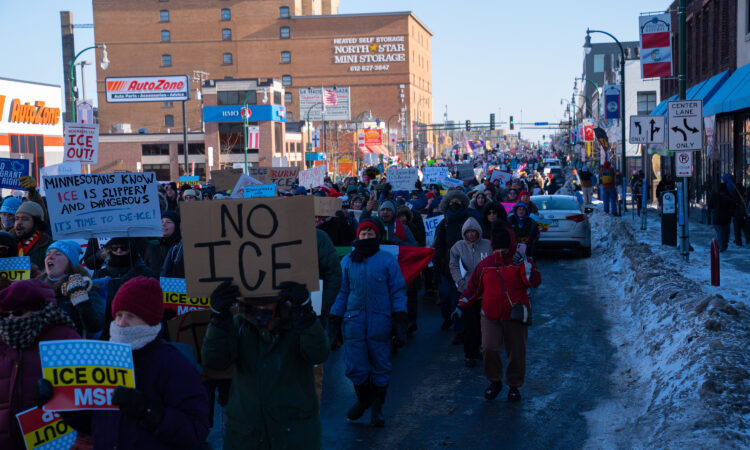
Following Pretti’s death, thousands of protesters gathered in downtown Minneapolis, demanding an end to the aggressive tactics employed by masked federal agents. These demonstrations highlighted the community’s growing unease regarding the treatment of immigrants, including those who possess legal documentation.
Business Leaders Forge a Middle Path
Business leaders are navigating a complex landscape, seeking to bridge the divide between local officials and federal authorities. Doug Loon, President and CEO of the Minnesota Chamber of Commerce, recently met with Vice President JD Vance to discuss the situation. Loon underscored the need for constructive engagement to restore community stability and economic confidence.
Former Minnesota Governor Arne Carlson has suggested that non-political leaders could play a pivotal role in mediating the conflict. He proposed that figures like former Chief Justice Kathleen Blatz and Hormel’s interim CEO Jeff Ettinger could convene discussions aimed at reducing tensions and creating a framework for collaboration.
Meanwhile, business leaders are being encouraged to speak out more forcefully against the federal operations. Bill George, a former Medtronic CEO, has expressed disappointment at the silence of many executives during this critical time. He believes that leaders have a responsibility to advocate for the safety and well-being of their employees.
In a recent commentary, former U.S. Treasury Secretary Robert Rubin emphasized the importance of accountability among business leaders, urging them to reflect on their positions regarding government actions. He posed three critical questions for leaders to consider, highlighting the potential risks of remaining silent in the face of authoritarianism.
The open letter from the Minnesota Chamber of Commerce stands as a testament to the business community’s desire for peace and cooperation. It calls for a united effort from all levels of government to ensure that families and businesses can thrive in a stable environment.
As Minnesota grapples with these issues, the involvement of business leaders may prove crucial in shaping a future where community safety and economic viability can coexist. The road ahead will require dialogue and commitment from all parties involved to navigate the complexities of immigration enforcement and public safety.