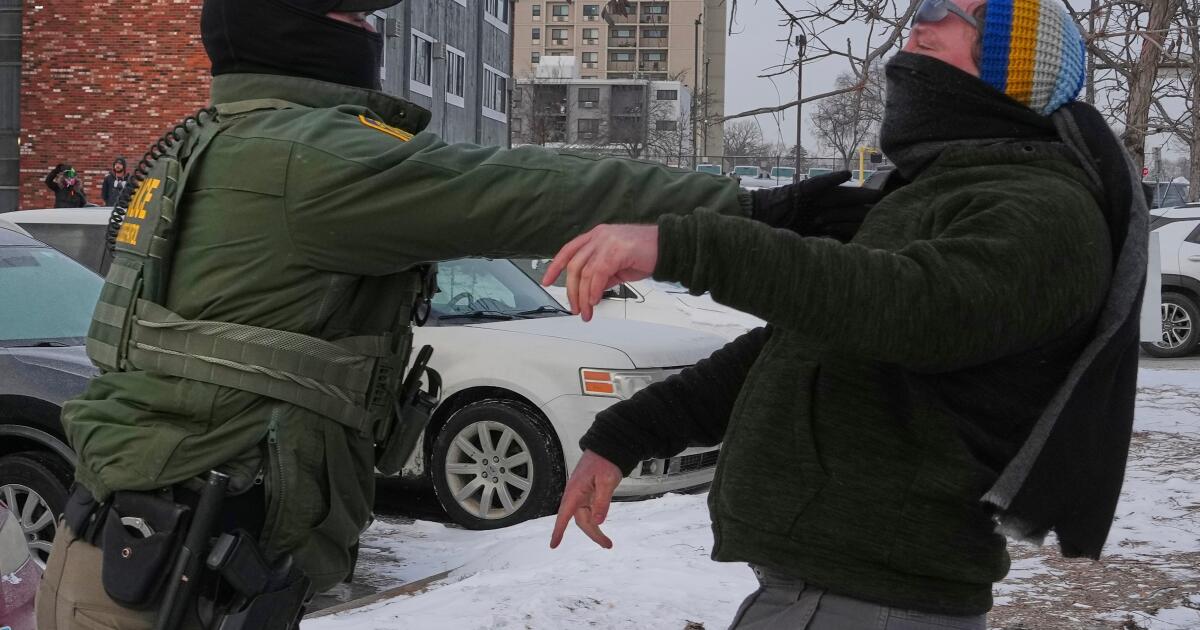
The Trump administration has come under fire for its handling of the recent shooting incident in Minneapolis, where immigration agents shot and killed Alex Jeffrey Pretti, a 37-year-old intensive care nurse. The administration quickly blamed Pretti for his own death, labeling him an “assassin” and “domestic terrorist,” without initiating an independent investigation into the circumstances surrounding the incident. This marks the second fatal shooting involving immigration agents in March 2024, raising significant concerns about the administration’s crisis response strategies.
Political Fallout and Public Outrage
The shooting, which occurred during a confrontation with Immigration and Customs Enforcement (ICE) agents, has triggered widespread public outrage and political repercussions. Video footage circulating on social media shows Pretti attempting to assist a fellow civilian who had been pushed by an ICE officer before he was shot ten times at close range by agents. Many observers noted that he did not appear to brandish his legally owned firearm during the encounter.
Homeland Security Secretary Kristi Noem asserted that Pretti had attended a protest with violent intentions, a claim that has been met with skepticism. Many in the public and political spheres have criticized the administration for its hasty judgment and lack of transparency. The National Rifle Association issued a statement emphasizing the need for a full investigation rather than the swift demonization of a law-abiding citizen.
The incident has become a focal point for political tensions, particularly among Republicans. A growing number of party members are expressing concern that the administration’s enforcement tactics have become excessively harsh. Polls now indicate that a plurality of Americans disapprove of the current approach to immigration enforcement, with one in three Republicans voicing apprehensions about its severity.
Impact on Immigration Policy and Administration Credibility
In the wake of the shooting, negotiations in Congress concerning ICE funding were disrupted, highlighting potential ramifications for the administration’s immigration policy. A Trump-appointed judge has also intervened, blocking efforts to destroy evidence related to the case, which has intensified fears of a cover-up.
Brian O’Hara, the police chief of Minneapolis, expressed his disappointment in the administration’s actions, stating, “People have had enough.” O’Hara pointed out the stark contrast between the incident involving Pretti and the overall efforts of the Minneapolis Police Department, which had managed to recover around 900 firearms without any shootings occurring in the previous year.
Earlier in March, another tragic incident occurred when Renee Nicole Good, a 37-year-old mother of three, was also killed by an ICE agent. Similar to Pretti’s case, the justification for Good’s shooting came swiftly, with senior officials casting doubts on her motivations without providing substantial evidence.
The aggressive rhetoric from the Trump administration follows a series of missteps in public communication, including the president’s recent confusion over geographical facts during a speech in Switzerland. This has amplified frustrations among key allies and stakeholders, who expect a more coherent and responsible approach from their leadership.
As the situation continues to unfold, the administration’s failure to effectively manage its response to these incidents poses significant questions about its credibility and the future of immigration enforcement in the United States.