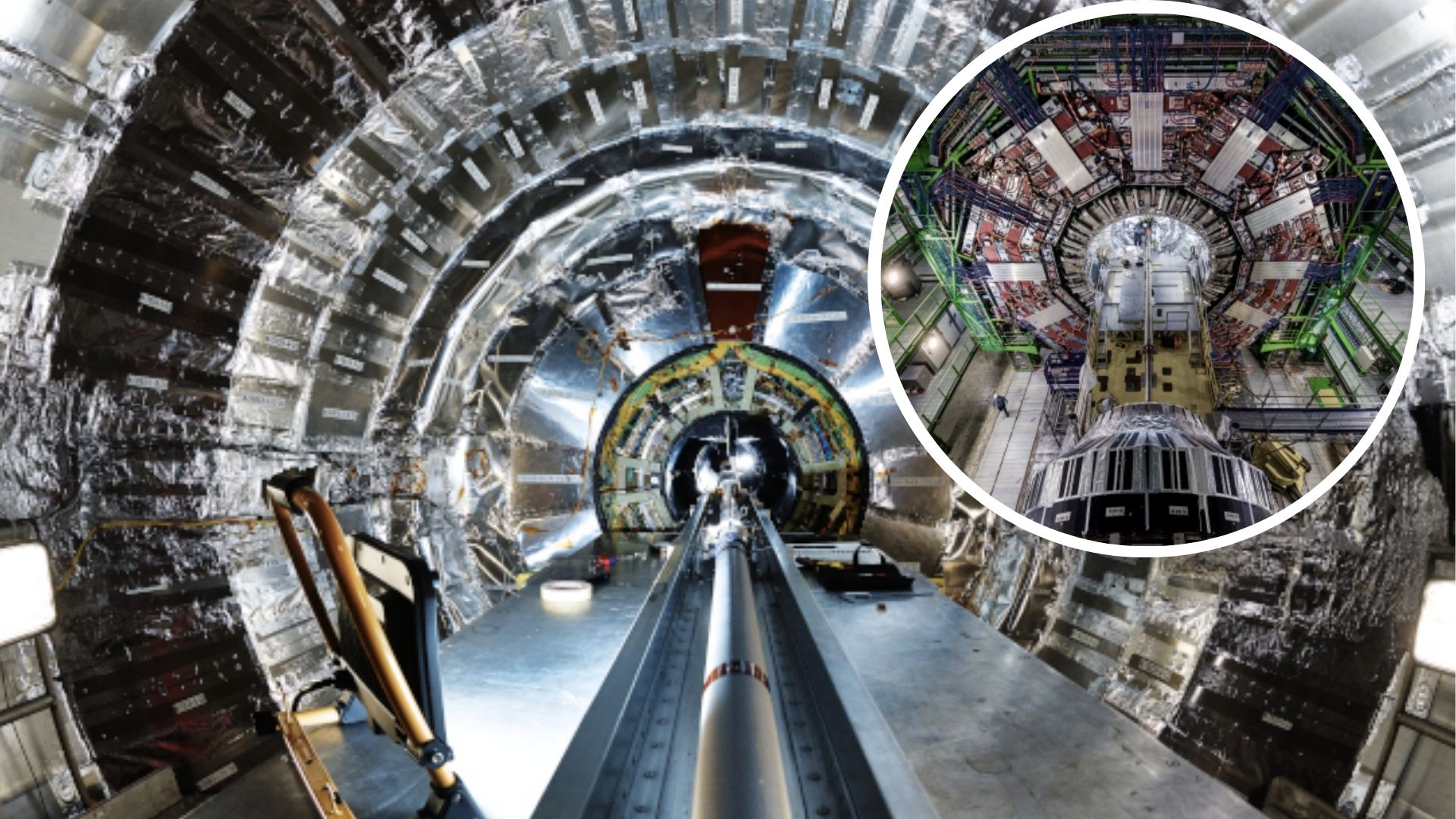
Recent research at the Large Hadron Collider (LHC) has provided new insights into the behavior of particles resulting from heavy-ion collisions. Scientists have observed a flow pattern that reflects the collective behavior of these particles, enhancing our understanding of the conditions that mimic the universe shortly after the Big Bang. This discovery is crucial as it unveils the dynamics of the quark-gluon plasma (QGP), a state of matter thought to have existed in the early universe.
Jiangyong Jia, a physicist at Stony Brook University and the Brookhaven National Laboratory, played a key role in leading the new ATLAS analysis. He stated that the findings confirm the fluid-like nature of the QGP while revealing something new about the “radial” flow of particles. This type of flow differs from the previously studied “elliptic” flow, offering insights into the viscosity within the fluid system created during collisions.
Collaboration and Complementary Findings
The new measurements from the ATLAS experiment are further supported by results from the ALICE detector, another experiment at the LHC. Both teams published their findings in the same issue of Physical Review Letters. According to Peter Steinberg, a physicist at Brookhaven Lab and co-author of the ATLAS paper, these radial flow measurements contribute to a narrative that began with the first data from the Relativistic Heavy Ion Collider (RHIC) in 2001.
The initial data from RHIC revealed distinct directional differences in particle flow patterns resulting from collisions of gold ions, which simulate conditions similar to those of the Big Bang. This research uncovered an elliptical particle flow pattern, where more particles emerged along the reaction plane defined by the colliding ions, rather than transversely. The researchers proposed that this flow resulted from the asymmetric pressure gradients within the oblong fireball created during the collisions.
Understanding Particle Behavior
The observable collective behavior of particles indicated that quarks and gluons continue to interact even after being liberated from their confined states within protons and neutrons. The elliptic flow was particularly remarkable, leading physicists to describe it as a nearly frictionless liquid with extremely low shear viscosity.
Jia emphasized that the new findings at the LHC build upon the foundation established by RHIC. By examining radial flow, scientists can gain a deeper understanding of the different geometric origins and viscosity types within the particle fluid. This ongoing research not only enhances our knowledge of fundamental physics but also sheds light on the conditions that shaped the early universe.
The collaborative efforts of scientists from the U.S. Department of Energy’s Brookhaven National Laboratory and Stony Brook University have been instrumental in advancing this important area of nuclear physics research. As these groundbreaking studies continue, they promise to reveal even more about the nature of matter and the forces that govern our universe.