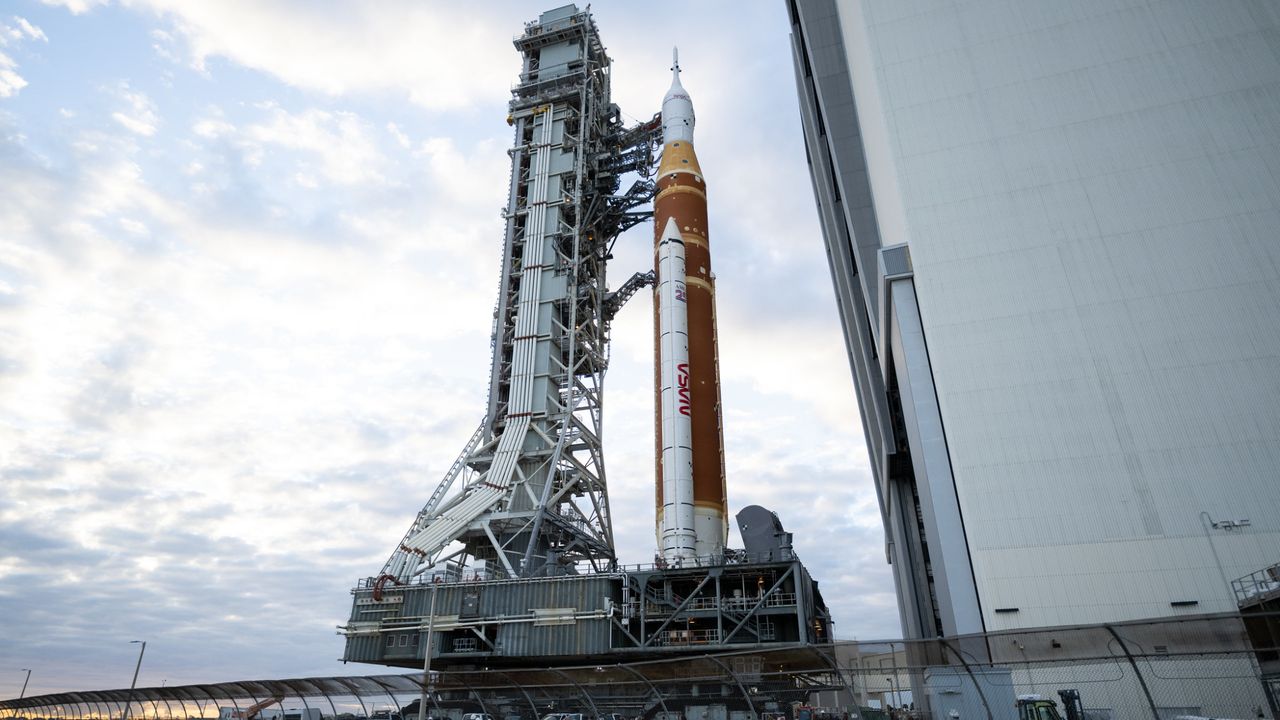
NASA’s Space Launch System (SLS) rocket is en route to its launch pad, marking a significant step toward the Artemis 2 mission, which aims to send astronauts to the moon. The rocket departed from the Vehicle Assembly Building (VAB) at Kennedy Space Center in Cape Canaveral, Florida, on January 17, 2024, beginning a four-mile (6.4 kilometers) journey to Launch Complex-39B (LC-39B). This mission is poised to lift off as early as February 6, 2024.
Engineers have spent the last year and a half preparing the Artemis 2 SLS, which rolled out for the first time as a fully assembled launch vehicle. The rollout commenced at 07:04 EST (12:04 GMT), with the rocket resting on its Mobile Launch Platform (MLP). The MLP features massive treads that slowly maneuvered the rocket from the VAB onto the road leading to the launch pad. Standing at 322 feet (98 meters) tall and weighing approximately 2,870 tons (2,600 metric tons) when fully fueled, the SLS is equipped with two solid rocket boosters and four RS-25 engines, together generating 8.8 million pounds of thrust at liftoff.
The journey to LC-39B will proceed at a pace of less than 1 mph (1.6 kph), expected to take between eight to ten hours. Following the rocket’s arrival, NASA will perform essential systems integrations and vehicle checks in preparation for a wet dress rehearsal, scheduled for February 2, 2024. This rehearsal will simulate a countdown to launch, setting the stage for an actual launch attempt shortly thereafter.
The Artemis 2 mission will carry NASA astronauts Reid Wiseman, Victor Glover, Christina Koch, and Canadian Space Agency astronaut Jeremy Hansen aboard the Orion spacecraft. Their mission is anticipated to last around ten days, during which they will travel around the moon. While February 6 is the earliest target date for launch, the timeline is contingent upon successful systems checks at the launch pad. Backup launch opportunities are available through February 11, alongside additional windows in March and April.
Artemis 2 is the second mission in NASA’s Artemis program, following the uncrewed Artemis 1 mission that launched in November 2022. The first Artemis 1 mission faced numerous challenges, including cryogenic hydrogen leaks and weather delays, resulting in several trips back to the VAB for maintenance. NASA officials are optimistic about avoiding similar setbacks with Artemis 2, expressing confidence in the rocket’s readiness for its upcoming mission.
Once launched, the SLS will deliver Orion into Earth orbit, where the crew will conduct systems checks before executing a translunar injection burn to set their course for the moon. This crucial maneuver will be performed by SLS’s interim cryogenic propulsion stage, after which Orion will detach to carry out proximity maneuvering tests en route to lunar space.
Unlike previous missions, Artemis 2 will not enter lunar orbit. Instead, it will utilize a “free-return trajectory,” allowing the capsule to loop around the moon and return to Earth, ensuring the safety of the crew even if any anomalies arise during the flight.
The Artemis 2 mission represents a pivotal step in NASA’s long-term goal of returning astronauts to the lunar surface, with plans to establish a base in the moon’s south polar region. The subsequent Artemis 3 mission is designated to achieve a lunar landing, contingent on the success of Artemis 2.
As preparations continue for Artemis 2, the crew members have been conducting launch-day rehearsals at Kennedy Space Center, familiarizing themselves with the mission’s protocols. Their presence at the rollout underscored their commitment and readiness for this historic endeavor.