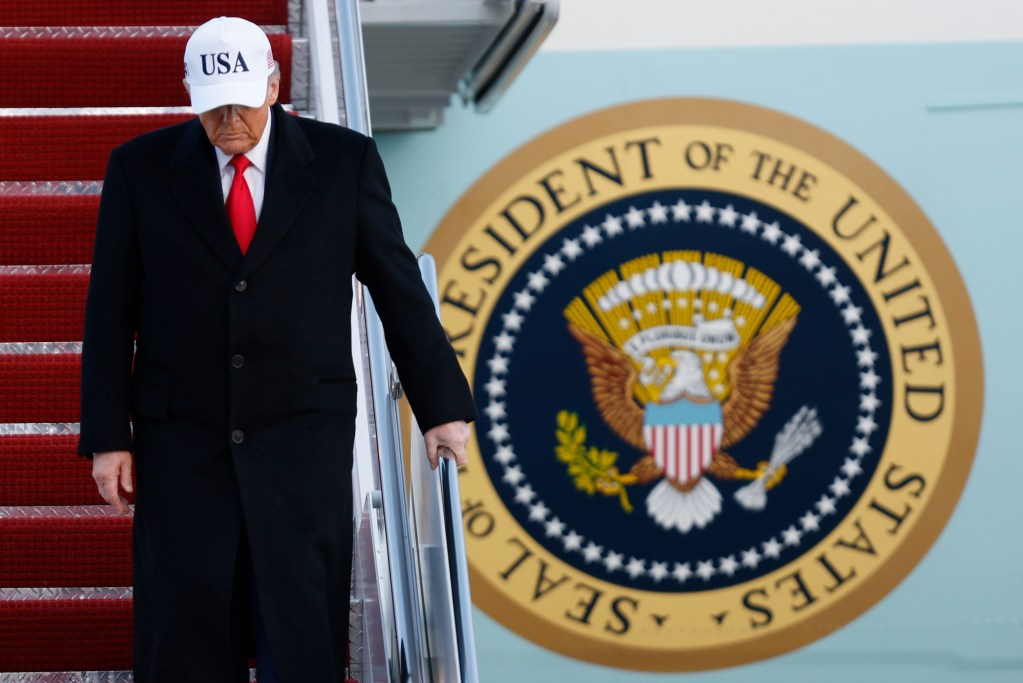
UPDATE: President Donald Trump has announced a significant policy shift that will deny federal funding to any state harboring sanctuary cities, starting on February 1, 2024. This urgent move, revealed during a speech at the Detroit Economic Club, aims to penalize local governments that resist the administration’s immigration enforcement strategies.
Trump stated, “We’re not making any payments to sanctuary cities or states having sanctuary cities, because they do everything possible to protect criminals at the expense of American citizens.” His remarks underscore a growing tension between federal and local authorities on immigration issues, with potential repercussions for millions of Americans.
This decision could drastically affect funding across the U.S., targeting regions known for their reluctance to cooperate with Immigration and Customs Enforcement (ICE). While no strict definition for sanctuary cities exists, they typically limit their cooperation with federal immigration enforcement. Trump’s administration views this resistance as a direct threat to public safety.
Despite previous attempts to cut off funding to sanctuary jurisdictions being blocked by courts, Trump insists his forthcoming actions will be “significant.” When pressed on which federal funds would be impacted, he remained vague but assured reporters that details would soon emerge.
Historically, efforts to withhold federal funding from sanctuary cities have faced legal challenges. In 2017, Trump’s administration attempted similar measures, which were overturned by the courts. Legal experts suggest that this latest initiative may encounter similar obstacles, particularly given the mixed responses from various jurisdictions.
According to the Justice Department, a list of over three dozen sanctuary jurisdictions includes politically Democratic-controlled areas like California, New York, Boston, and counties such as Baltimore and Cook County. Many officials from these regions have criticized the administration’s approach, arguing it lacks clarity and fairness.
Moreover, this announcement comes amid broader federal funding disputes. Recently, the U.S. Department of Agriculture has threatened to withhold funding from states that fail to provide required data on Supplemental Nutrition Assistance Program recipients. In addition, the U.S. Department of Health and Human Services has paused funding to five Democratic-led states over fraud suspicions, although these measures have also faced legal intervention.
As tensions rise, states like Minnesota are already feeling the heat, with the Agriculture Department freezing funding over vague fraud claims. The Centers for Medicare and Medicaid Services has warned Minnesota that it might withhold $515 million every three months from Medicaid programs deemed “high risk.”
This unfolding situation is urgent and carries significant implications for millions of families relying on federal support. As the administration moves forward with its plans, it remains to be seen how local governments will respond and whether legal challenges will once again stall these efforts.
In the coming weeks, watch for updates on how this policy will be implemented and the potential legal ramifications that could arise as states and localities push back against federal overreach.