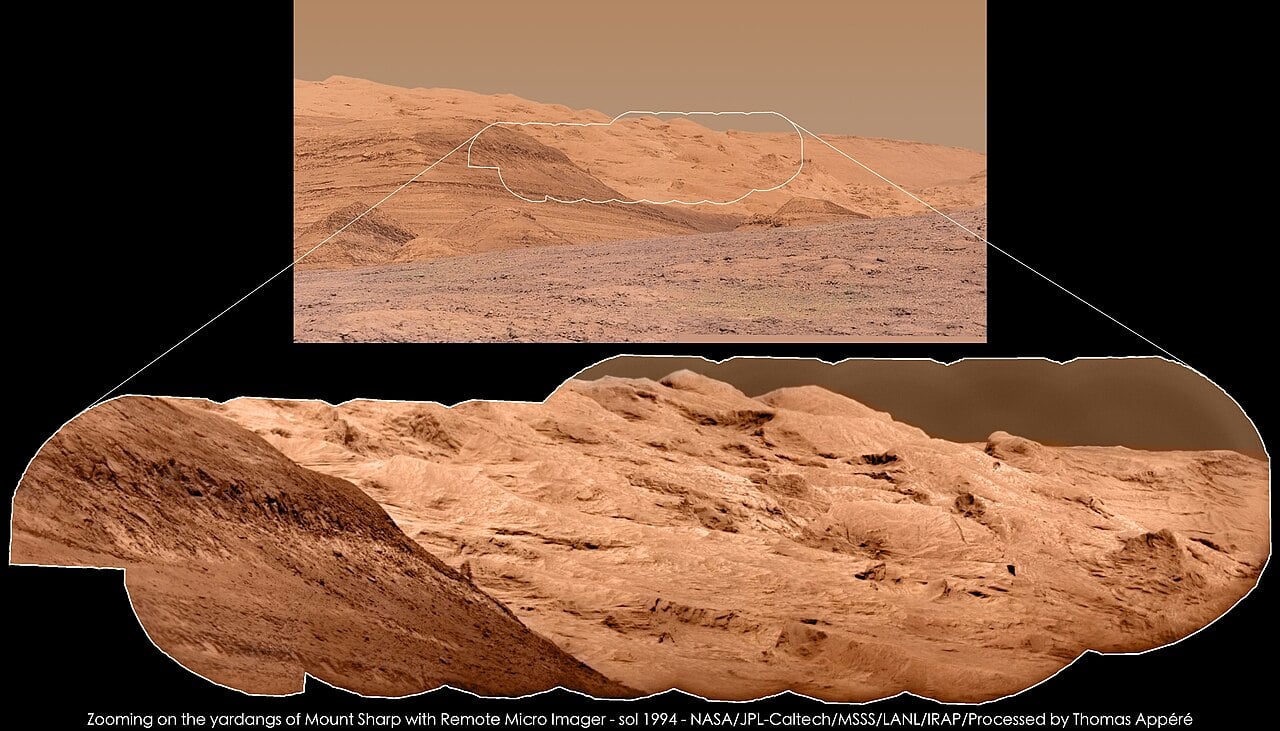
Martian winds are revealing their powerful impact on the landscape of the Red Planet, as new images from the European Space Agency’s (ESA) Mars Express spacecraft showcase stunning examples of erosion. Captured near the equator of Mars, these images highlight features known as yardangs—elongated ridges formed by the relentless action of wind over millions of years.
The images depict a region nearly the size of Belgium at the northern end of the Eumenides Dorsum mountains. Yardangs stand prominently, marking areas where softer terrain has been eroded away. This process begins when Martian winds lift sand grains and accelerate them across the surface. Acting as abrasives, these particles exploit weaknesses in the sedimentary rock layers, carving out intricate patterns. Over time, this relentless wind erosion leaves behind the more resistant portions of rock, forming the yardangs.
Understanding Yardangs and Martian Erosion
One of the intriguing aspects of these yardangs is their uniform orientation, with each ridge slanting in the same direction, curving in from the southeast. This consistent alignment serves as a geological weather vane, documenting the prevailing wind direction on Mars. While the Martian atmosphere is thin compared to Earth’s, the winds have demonstrated remarkable persistence over geological timescales, shaping the planet’s surface in profound ways.
The images from Mars Express also reveal a relatively fresh impact crater, complete with a blanket of ejecta radiating from the site of an asteroid impact. Alongside this, planetary scientists have identified features known as “platy flow,” which represent ancient lava that crusted over as it moved across the landscape. The ongoing movement beneath this solid layer caused fractures, resulting in sections that drifted similarly to ice flows on Earth’s polar regions.
These three geological processes—wind erosion, impact cratering, and volcanic activity—intersect in this unique Martian landscape. The yardangs are believed to have formed atop the platy flow, indicating that they are relatively recent additions to this ancient volcanic terrain.
Decades of Observation and Discovery
Since its launch in 2003, Mars Express has provided critical insights into the diverse geological processes shaping Mars. The continuous observations over more than two decades have enhanced our understanding of the interplay between wind, water, volcanism, and impacts. Each new image contributes to a comprehensive portrait of the Red Planet, highlighting how these fundamental forces have collaborated to create the Mars we observe today.
As scientists continue to analyze these findings, the investigation into Martian geology promises to unveil further details about the planet’s history and its evolving landscape. The ongoing exploration serves not only to satisfy humanity’s curiosity about our solar neighbor but also informs potential future missions that may one day seek to unlock the mysteries of Mars more fully.