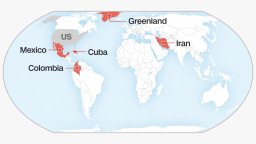
In a striking announcement over the weekend, US President Donald Trump suggested a military campaign targeting Mexican drug-trafficking organizations. This statement came shortly after the US conducted operations against Venezuelan leader Nicolás Maduro, accused of “narco-terrorism.” Trump expressed his frustration with the Mexican government’s repeated rejection of his offers to combat the cartels, stating, “We have to do something” about the challenges posed by America’s southern neighbor.
During an interview with Fox News, Trump mentioned that his administration has successfully eliminated 97% of drug shipments arriving by water and plans to shift focus to land-based operations against the cartels. Mexico, as the primary supplier of fentanyl to the US and a critical transit route for cocaine from Colombia, has become a focal point in Trump’s narrative of a war on drugs.
Despite the apparent logic in targeting Mexican cartels, experts argue that Trump’s understanding of the situation is oversimplified. The drug trafficking landscape in Mexico has evolved significantly. According to Eduardo Guerrero, director of Lantia Intelligence, the number of criminal groups has surged to around 400, replacing the once-dominant cartels like those led by infamous figures such as Joaquín “El Chapo” Guzmán.
Complexity of the Cartel Landscape
The fragmentation of these groups indicates that the traditional strategy of targeting key leaders may no longer be effective. “The biggest cartels have become more sophisticated,” Guerrero noted, highlighting that the Jalisco New Generation Cartel now comprises approximately 90 organizations, an increase from 45 in previous years. This evolution necessitates a more nuanced approach to dismantling these networks.
Following a decade-long campaign starting around 2007, Mexican authorities, supported by US intelligence, captured numerous high-profile cartel leaders. Despite these efforts, drug trafficking operations remained largely unaffected, with tons of narcotics still crossing the border. Benjamin T. Smith, an author and expert on the drug trade, emphasized that eliminating a cartel leader is akin to targeting the CEO of a corporation: it does not halt the overall operations. “As long as there is demand for drugs, there will be a supply,” he stated.
Analysts point out that the strategy of targeting kingpins has led to a fracturing of cartels into smaller factions, which now often engage in violent conflicts for territory. These groups impose “taxes” on local businesses and even on drug smugglers, creating a web of economic control that complicates law enforcement efforts.
Challenges in Mexican Governance
The situation in Mexico is further complicated by the lack of a unified power structure. According to researcher Falko Ernst, “no one is firmly in control, neither the cartels nor the government.” In some regions, the government maintains authority, while in others, armed groups operate freely, creating a “mosaic” of power dynamics. This diversity of control complicates the implementation of a singular strategy to combat drug-related violence.
The intertwining of cartels with local economies and politics has become increasingly apparent. During the 2024 national elections, crime groups reportedly sought to influence local governance by attempting to install their own candidates. The campaign was marred by violence, with multiple candidates killed and many others intimidated into withdrawal.
Removing cartel leaders does not address the underlying support structures that have formed. The Science magazine reported in a 2023 study that cartels employ between 160,000 and 185,000 individuals across Mexico, suggesting that these organizations have integrated deeply into local economies.
In response to inquiries about the Trump administration’s approach, White House spokeswoman Anna Kelly cited the recently issued National Security Strategy, reaffirming commitments to combat drug trafficking and control migration. She indicated that the administration has various options to protect the US from illicit narcotics that contribute to a growing number of fatalities.
While Mexico’s President maintains a working relationship with the Trump administration, she has firmly rejected the idea of US troops entering Mexican territory. Claudia Sheinbaum has emphasized the importance of Mexico’s sovereignty, indicating a desire to collaborate without being viewed as subservient to US directives.
Sheinbaum’s caution stems from historical memories of US military interventions in the region, which could provoke public backlash and exacerbate tensions within her leftist political party and the military. The potential for violence resulting from US military actions is a significant concern.
The Pacific state of Sinaloa serves as a warning for what can happen when cartel leaders are forcibly removed. An operation in which US authorities collaborated with Mexican traffickers led to the capture of cartel leader Ismael “El Mayo” Zambada, resulting in a violent power struggle within the cartel that has left countless individuals dead or missing.
Despite Trump’s assertions that “we have to do something” about drug trafficking, Sheinbaum has undertaken her own measures, mobilizing thousands of troops to the US border to intercept narcotics and migrants. She has also transferred numerous drug-trafficking suspects to the US, which indicates her administration’s proactive stance against the issue.
Trump’s recent remarks have sparked uncertainty regarding US-Mexico relations. The US’s actions against Maduro are seen as a demonstration of its willingness to exert influence in its immediate neighborhood, creating a new power dynamic that could affect the entire Latin American region.
In summary, the complexities of the Mexican drug trafficking landscape and the interplay between cartels and governance highlight the challenges of formulating effective strategies to combat this pervasive issue. As discussions of military intervention surface, the implications for bilateral relations and regional stability remain to be seen.