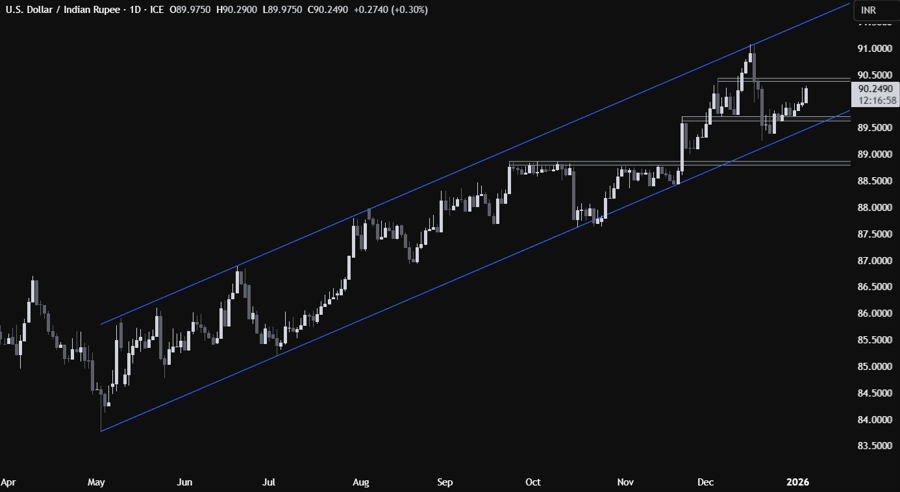
The exchange rate between the United States Dollar (USD) and the Indian Rupee (INR) is under scrutiny following renewed threats from former President Donald Trump regarding tariffs. On December 26, Trump indicated that additional tariffs could be imposed on India unless the country curbs its imports of Russian oil. This geopolitical tension adds to the complexities facing the INR, particularly as it approaches the critical exchange rate level of 90.40.
Throughout the Christmas week, the USD weakened before recovering most of its losses. Typically, trading during the holiday period is characterized by low volume and volatility, which often results in price fluctuations that do not reflect long-term trends. Despite this temporary instability, fundamental economic indicators remain largely unchanged. Recent reports from the Federal Reserve revealed softer than expected Non-Farm Payroll (NFP) and Consumer Price Index (CPI) figures, reinforcing market expectations for potential interest rate cuts. Currently, investors anticipate a 63 basis points easing by the end of the year.
As the market awaits further economic data, analysts note that December’s figures may have been skewed due to government shutdown issues. A clearer picture is anticipated with upcoming releases, especially as the Fed is not expected to implement rate cuts until at least March 2024. If subsequent data indicates persistent weakness, the market could adjust its expectations for easing in 2026, which would likely put additional downward pressure on the USD.
The INR experienced a brief relief rally following intervention by the Reserve Bank of India (RBI) on December 17. However, the overarching trend for the Rupee remains downward, as gains have already begun to dissipate with the USD/INR pair approaching the significant 90.40 level. The potential for a sustained rally in the USD against the INR is contingent upon breaking through this resistance level.
Technical analysis on the daily chart shows that the USD/INR fell back to the lower boundary of its rising channel after the RBI’s intervention. Buyers entered the market around this trendline, pushing prices above the 89.70 threshold, thereby increasing bullish sentiment towards the resistance at 90.40. A decisive break above this level would pave the way for a new record high.
On the four-hour chart, strong resistance is visible around the 90.40 mark, where sellers are likely to re-enter the market, placing defined risk above this resistance to target a drop to 89.60. Conversely, buyers are eager for a breakout, which would signal a potential rally.
Additionally, the week ahead will see several important economic indicators released in the United States. The US ISM Manufacturing PMI is due today, followed by the US ADP employment report, ISM Services PMI, and Job Openings data on Wednesday. On Thursday, the latest figures for US Jobless Claims will be published, culminating in the highly anticipated NFP report on Friday.
As traders and analysts closely monitor these developments, the USD/INR exchange rate will likely reflect the ongoing interplay of economic data, geopolitical tensions, and market sentiment in the coming days.