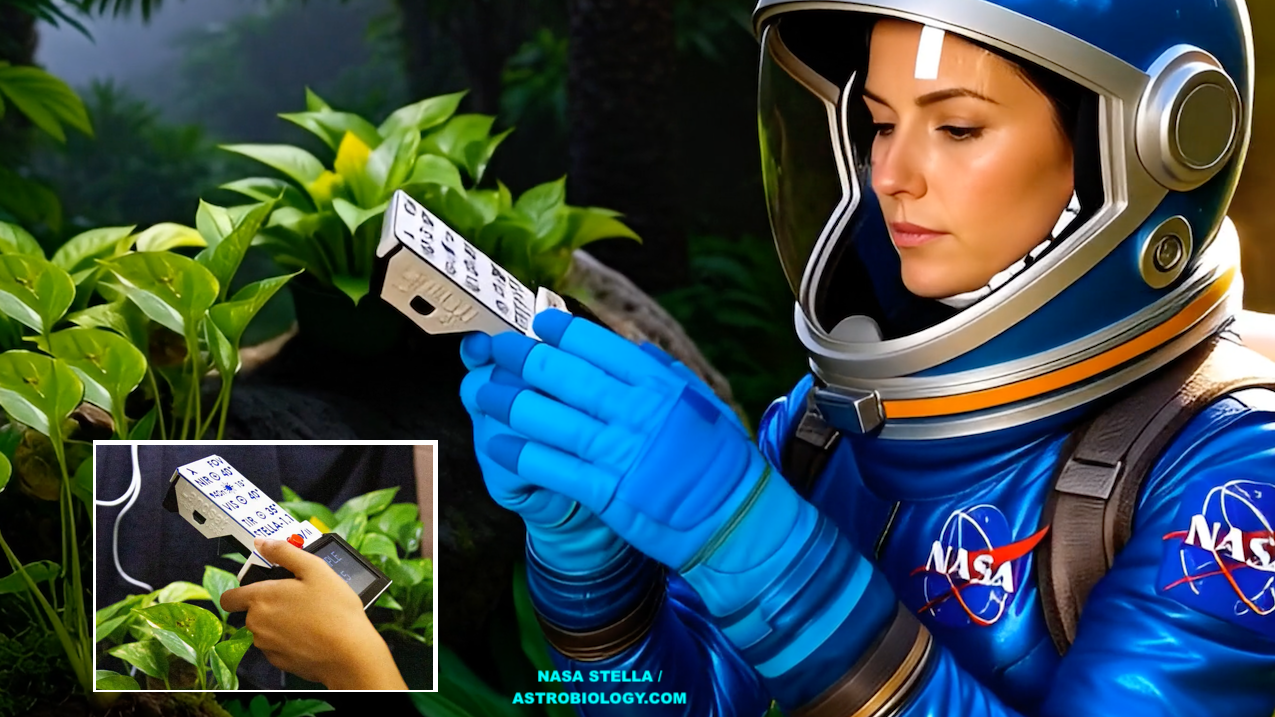
NASA has introduced an innovative approach to remote sensing through its new project known as STELLA, which stands for Science and Technology Education for Land/Life Assessment. This initiative aims to democratize access to sensor technology by enabling individuals with diverse interests to build and utilize low-cost instruments that can aid in environmental observation and research. The comprehensive paper detailing this project, titled “Democratizing Remote Sensing Science With Low-Cost Open-Source Instruments for Research and Education,” is available online as an open-access resource.
The STELLA instruments are designed to allow users to scan, record, and analyze various environmental features, including plant health. For instance, during recent tests at NASA’s Goddard Space Flight Center in Greenbelt, Maryland, researchers monitored two plants with differing water levels using STELLA, demonstrating its potential in practical applications.
NASA scientists, in collaboration with university researchers, have developed lightweight, affordable remote sensing devices that can be constructed from commercially available components. These instruments measure light spectra across 18 channels in the visible and near-infrared ranges, facilitating detailed observations and evaluations of vegetation reflectance characteristics. The simplest model, the STELLA-Q, can be assembled for approximately $200 and requires minimal technical skills, making it accessible to a broad audience.
Empowering Future Explorers
The STELLA project is particularly aimed at engaging younger generations, often referred to as the Artemis Generation, who are poised to explore other worlds in the future. This initiative not only provides hands-on learning experiences but also encourages analytical thinking and a deeper understanding of the scientific process. The open-source nature of the project allows for widespread distribution of knowledge, with instructional materials and software available online.
NASA’s commitment to citizen science is evident in the collaboration with the University of Virginia and various educational institutions, fostering a community of DIY enthusiasts and aspiring scientists. The instruments are designed to support educational programs that integrate remote sensing technologies into curricula, providing students with practical skills that may serve them in future scientific endeavors.
Advancing Scientific Research
As humanity aims to explore other planets, the ability to conduct in situ analysis becomes increasingly crucial. The STELLA instruments facilitate real-time data collection, allowing researchers to transmit findings back to Earth almost instantaneously. This capability not only reduces the logistical challenges associated with sample return missions but also enhances the overall efficiency of exploratory missions.
The STELLA instruments are also equipped with open-source software, written in a simplified variant of the Python programming language, which enhances accessibility for users. Data collected is stored in plain text format on a micro-SD card, making it easy to retrieve and analyze. This simplicity encourages broader participation in scientific research, potentially leading to new discoveries in remote sensing and environmental monitoring.
As the STELLA project continues to develop, it reflects NASA’s vision to empower communities globally through accessible science and technology. The initiative is supported by the NASA Science Mission Directorate and relies on the expertise of numerous contributors from the Earth Sciences Division and beyond.
In summary, NASA’s STELLA project represents a significant step forward in making remote sensing technologies available to the public. By equipping citizen scientists with the tools to explore and understand their environments, NASA is not only advancing scientific knowledge but also inspiring the next generation of researchers and explorers. The complete findings and details about the project can be accessed through NASA’s dedicated STELLA webpage.