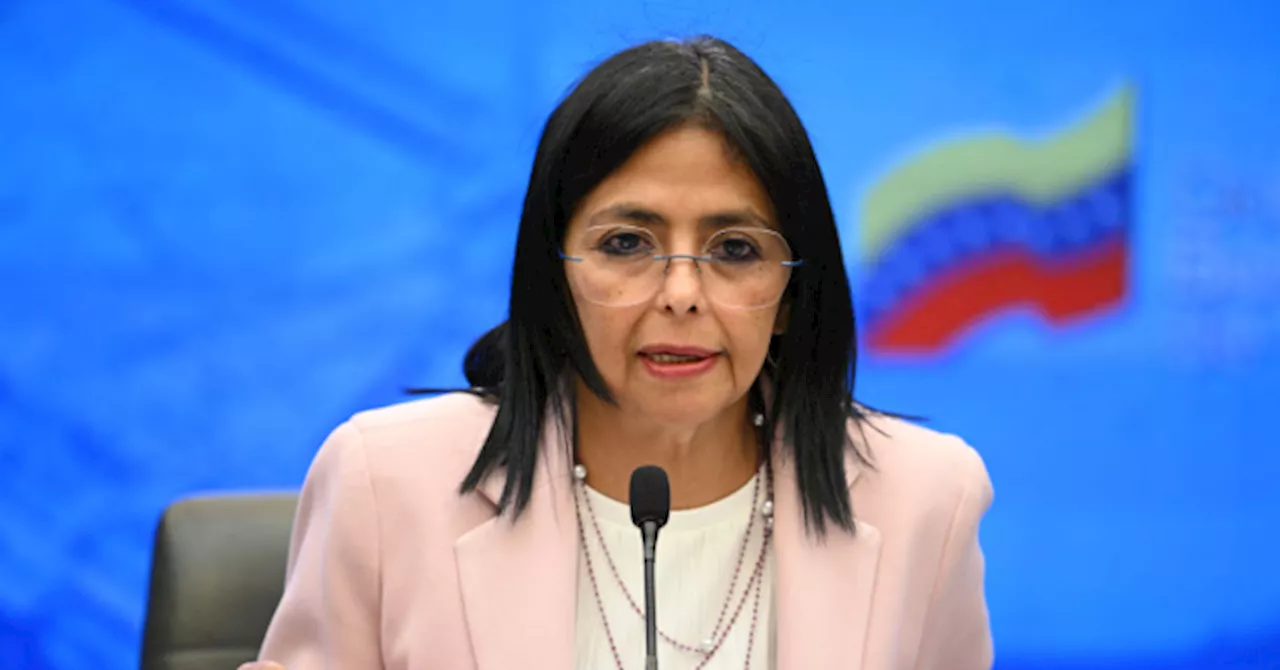
President Donald Trump announced on Saturday that Venezuelan Vice President Delcy Rodríguez has expressed a willingness to collaborate with the United States to improve conditions in Venezuela. This statement came shortly after reports indicated that Rodríguez had been sworn in as the head of state, following the recent capture of President Nicolás Maduro and his wife, Cilia Flores, by U.S. forces.
During a press conference, President Trump noted, “I understand she was just sworn in, but she was, as you know, picked by Maduro. Marco [Rubio] is working on that directly. He just had a conversation with her, and she’s essentially willing to do what we think is necessary to make Venezuela great again.” The president highlighted the crucial role that Marco Rubio, the Secretary of State, and Pete Hegseth, the Secretary of War, will play in this transition.
Rodríguez, who has served as Maduro’s vice president since 2018 and as oil minister since 2024, has held various significant positions within the Maduro administration over the past two decades. Her brother, Jorge Rodríguez, currently leads the socialist-controlled National Assembly, forming a powerful alliance within the regime.
The Venezuelan vice presidency is not an elected position; rather, it is appointed and can be replaced at the discretion of the president according to the nation’s constitution. This centralization of power has raised questions about the legitimacy of Rodríguez’s new role. In a recent statement, she demanded that the U.S. provide “proof of life” for Maduro and Flores, indicating a volatile situation within the Venezuelan government.
The U.S. Department of the Treasury’s Office of Foreign Assets Control imposed sanctions on both Delcy Rodríguez and her brother in 2018, alongside other high-ranking officials in the Maduro regime. The European Union has similarly sanctioned Rodríguez for her involvement in the government.
Trump’s comments come in the wake of significant military action in Venezuela. He confirmed that U.S. forces successfully captured Maduro during a military operation in Caracas, stating that the U.S. will oversee the transition of power in Venezuela.
In the aftermath of the operation, President Trump emphasized the importance of having a stable leadership structure in place, expressing concern over who would take over if the current regime were to collapse. He remarked, “Because for us to just leave, who’s gonna take over? I mean, there’s nobody to take over.”
The situation remains fluid, with Trump indicating that the U.S. would be actively involved in Venezuela’s future. He stated, “We’re making decisions on what’s next for Venezuela, and we’ll be involved in it very much.”
As the political landscape in Venezuela continues to evolve, the international community watches closely to see how these developments will impact the region and the lives of Venezuelans. The situation underscores the complexities of foreign intervention and the challenges of fostering democratic governance in a nation plagued by years of turmoil and authoritarian rule.