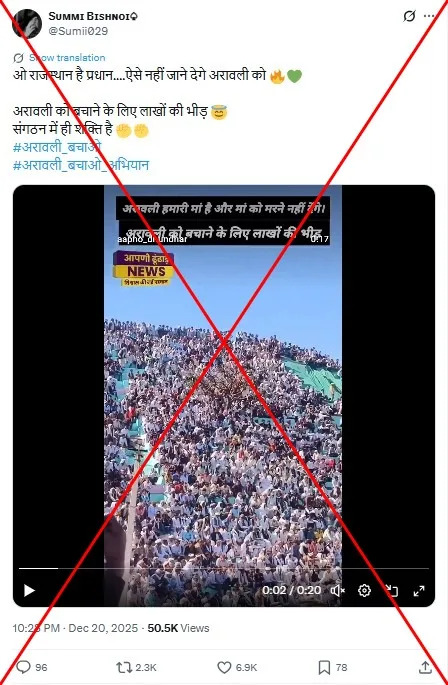
A video that circulated online claiming to show protests over a controversial Supreme Court decision in India has been misrepresented. The footage, shared widely on platforms like Facebook and X, actually depicts a community meeting held in January 2025, months prior to the court’s ruling.
The Supreme Court’s decision in November 2025 to redefine the boundaries of the Aravalli hills has sparked significant unrest among environmentalists. They believe this change could expose ecologically important areas to mining activities. The ruling specifically excludes regions under 100 metres (approximately 328 feet) in altitude from protection, raising concerns about the potential devastation of crucial ecosystems.
Protests erupted across India following the court’s announcement, with demonstrators rallying to protect the Aravalli hills, one of the oldest mountain ranges in the world, spanning across states such as Rajasthan, Haryana, Gujarat, and Delhi. Environmentalists have warned that the new definition could leave many vital hills vulnerable to mining and construction, as reported by India’s ANI news agency.
In response, the government asserted that the ruling aims to streamline regulations and enhance environmental protections rather than undermine them. On December 29, 2025, the Supreme Court suspended its own order and established an expert panel to further investigate the ecological implications of the decision.
Despite the ongoing protests, the video shared online does not reflect the situation surrounding the Supreme Court’s ruling. Instead, it captures a gathering known as a mahapanchayat that took place in January 2025 in a village in Rajasthan. This meeting, attended by between 12,000 and 13,000 people, was convened to address local disputes, specifically a cancelled wedding ceremony.
A reverse image search conducted on the video led to its earlier publication by local media outlet News18 on January 28, 2025. The report clearly identified the event as a community gathering, confirming its unrelated nature to the Supreme Court’s decision.
Amit Meena, a local resident who participated in the January meeting, emphasized that no protests occurred in his village concerning the Supreme Court ruling. He mentioned that the mahapanchayat was organized at a local wrestling ground, reinforcing the notion that the video is being misappropriated for political purposes.
The dissemination of this false narrative highlights the risks of misinformation, especially during times of heightened public sentiment. As the situation develops, it remains essential for media consumers to verify the context of viral content, especially those related to sensitive topics such as environmental protection and legal rulings.
Previous instances of similar misrepresentation have also been debunked by AFP, showcasing a pattern of viral visuals being misconstrued to fit specific agendas. Understanding the origins and context of such media is crucial in fostering a well-informed public discourse.