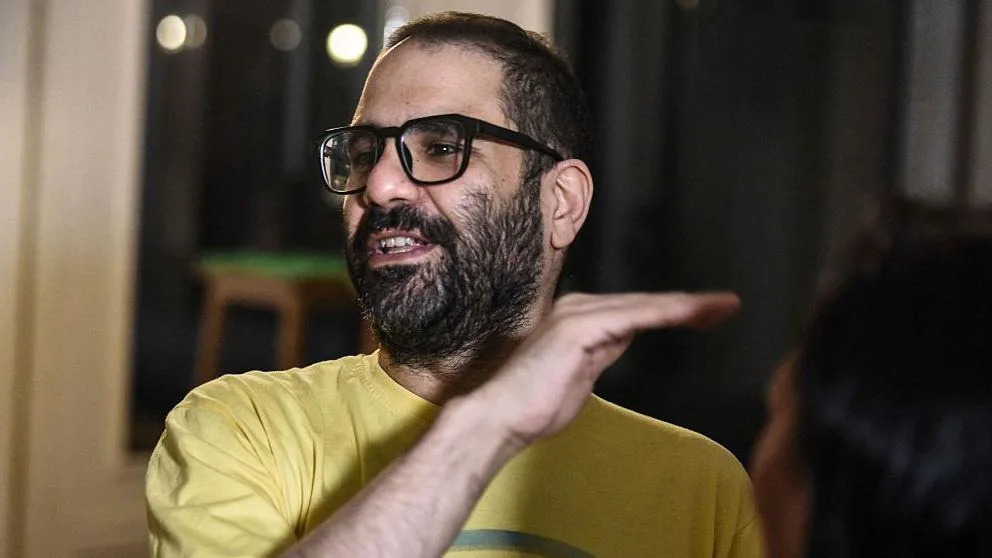
Egyptian democracy activist Alaa Abdel Fattah has issued an apology for a series of controversial tweets that have resurfaced following his recent arrival in the UK. Abdel Fattah, a dual national, was released from an Egyptian prison and arrived in the UK just days ago. His comments have sparked significant political debate, with leaders from the Conservative Party and Reform UK calling for his deportation.
The resurfaced tweets include statements that call for violence against police and Zionists. In response to the public outcry, Abdel Fattah stated, “I do understand how shocking and hurtful they are, and for that I unequivocally apologise.” He expressed his dismay that these historical posts are being used to question his integrity, especially at a time when he is reuniting with his family for the first time in twelve years.
Kemi Badenoch, the UK Home Secretary, and Nigel Farage, leader of Reform UK, have both suggested the possibility of revoking Abdel Fattah’s citizenship. Farage conveyed that anyone espousing what he termed “racist and anti-British views” should not be allowed entry into the UK. In a letter to Badenoch, he emphasized the need for thorough scrutiny of individuals seeking asylum or refuge in the country.
Political dynamics are further complicated by statements from Sir Keir Starmer, leader of the Labour Party, who faced criticism after expressing his delight at Abdel Fattah’s arrival. Critics have highlighted that Starmer may have been unaware of the activist’s past comments.
The UK Foreign Office, while acknowledging its efforts to secure Abdel Fattah’s release, condemned his tweets as “abhorrent.” Despite the criticism, they noted that Abdel Fattah’s case has been a long-standing priority for successive governments.
Abdel Fattah’s situation is particularly sensitive given his previous conviction in 2021 for “spreading fake news” in Egypt, a charge denounced by various human rights organizations as unjust. His citizenship, granted in December 2021 through his London-born mother, has come under scrutiny as political leaders call for his removal.
Shadow Home Secretary Chris Philp echoed calls for citizenship revocation, stating on BBC Radio 4 that there is “no excuse for what he wrote.” He emphasized that individuals expressing hatred and inciting violence have no place in the UK.
In one of the resurfaced tweets from 2012, Abdel Fattah reportedly stated, “I am a racist, I don’t like white people.” Another tweet indicated support for violence against colonialists and police, drawing condemnation from various political figures. Philp remarked on the severity of such language, stating, “There is no excuse for that kind of language.”
As international law prohibits rendering individuals stateless, any action taken against Abdel Fattah’s citizenship must consider his eligibility for citizenship in another country. Badenoch remarked that citizenship decisions should account for an individual’s social media activity and public statements.
With the political landscape shifting rapidly, the Board of Deputies of British Jews has expressed profound concern regarding Abdel Fattah’s past rhetoric. Senior Vice-President Adrian Cohen noted that his previous extremist comments pose a threat to the Jewish community and the public at large.
Abdel Fattah has maintained that some of his comments have been misinterpreted. He pointed out that certain allegations of homophobia were actually intended to mock such views. He stated, “I have paid a steep price for my public support for LGBTQ+ rights in Egypt and the world.”
A prominent figure during the 2011 uprising that led to former President Hosni Mubarak‘s downfall, Abdel Fattah has spent over a decade in prison. His recent release followed a presidential pardon and a lengthy campaign for his freedom led by family and supporters, including lobbying by the British government.
After being removed from a travel ban list imposed by Egyptian authorities, Abdel Fattah has been able to reunite with his 14-year-old son, who resides in Brighton. Despite the challenges he faces in the UK, he remains a vocal advocate against police brutality and repression in Egypt.
The unfolding situation reflects ongoing tensions surrounding free speech, political asylum, and the responsibilities of nations in dealing with individuals who have controversial histories. As discussions continue, the ramifications of Abdel Fattah’s past and present will undoubtedly shape the political discourse in the UK.