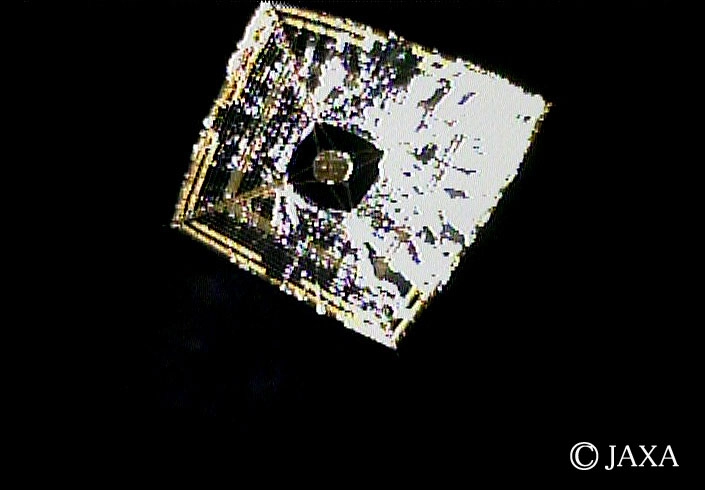
The realm of space exploration is set to advance with a new technique for controlling solar sails, developed by researchers at the University of Pennsylvania. In a pre-print paper, Gulzhan Aldan and Igor Bargatin introduce a method utilizing kirigami, an ancient Japanese art of paper cutting, to enhance the maneuverability of solar sails without the need for traditional propellant.
Solar sails have long been admired for their ability to harness sunlight for propulsion. Unlike conventional spacecraft that rely on fuel, solar sails catch sunlight to generate thrust. However, steering these sails presents a unique challenge. Traditional methods, such as reaction wheels and tip vanes, have limitations that can impact performance. Reaction wheels require propellant and add significant weight, while tip vanes can be mechanically complex and prone to failure.
The innovative kirigami technique offers a solution by incorporating intentional cuts into the sail material. Each segment of the solar sail is designed with a grid of cuts running in axial and diagonal directions across a standard material known as aluminized polyimide film. When pulled, these cuts allow the material to buckle, transforming the sail into a three-dimensional surface. This alteration enables individual sections to tilt relative to the light source, effectively acting like numerous tiny mirrors.
As the segments buckle, they redirect incoming light, creating a force that propels the sail in the opposite direction. This mechanism adheres to the principle of conservation of momentum, allowing precise control over the sail’s trajectory. Although some electrical power is required to operate the servo motors that induce the buckling, this power consumption is minimal compared to other control mechanisms, such as Reflectivity Control Devices (RCDs) used in previous missions.
To validate their approach, Aldan and Bargatin conducted simulations using COMSOL, a recognized physics simulation software. They executed a series of ray tracing experiments to assess the forces acting on the sail based on varying buckling and solar angles. The results indicated that, while the forces were small—approximately 1 nanonewton per Watt of sunlight—they were adequate to steer a small solar sail and its payload effectively.
The researchers also performed a physical experiment, placing a cut piece of film in a test chamber and shining a laser onto it while applying tension. The observed movement of the laser projections aligned closely with their theoretical predictions, confirming the functionality of the kirigami design.
This advancement could significantly lower the energy and propellant costs associated with steering solar sails, potentially revolutionizing future solar sailing missions. Despite the promise of this technology, it faces competition from other propulsion methods, and there are currently few experimental missions to test these innovations in real-world conditions. As such, it may take time before the kirigami approach is implemented in space.
Looking ahead, the implications of this technology are profound, with the potential to enhance the efficiency and effectiveness of solar sails. When ultimately deployed, these sails are expected to showcase not only innovative engineering but also stunning visual aesthetics as they navigate the cosmos.