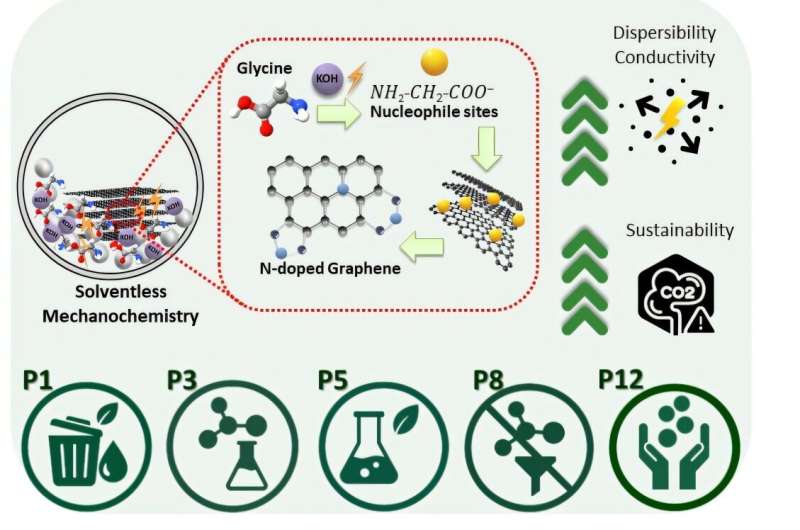
Researchers are making significant strides in the production of functionalized graphene materials, driven by a commitment to sustainability. A recent study led by Chamalki Madhusha at Monash University highlights a promising method for creating nitrogen-doped graphene nanoplatelets (N-GNPs) through a solvent-free, bio-derived mechanochemical approach. Published on December 25, 2025, in ACS Sustainable Chemistry & Engineering, this research addresses the environmental challenges associated with traditional graphene functionalization techniques.
Graphene, often hailed as a wonder material for its incredible strength and electrical conductivity, faces hurdles in practical applications. While pristine graphene possesses remarkable properties, many advanced uses require chemical modifications to enhance performance. Typical methods, such as nitrogen doping, can involve toxic reagents and high-energy processes that generate substantial waste. This raises concerns, especially as the demand for environmentally friendly manufacturing practices grows.
The study’s innovative approach utilizes mechanochemistry—a technique that employs mechanical forces to induce chemical reactions without the need for solvents. By employing a ball-milling method, the researchers successfully functionalized graphite with a bio-derived nitrogen source derived from amino acids. This process occurs under ambient conditions, eliminating the requirement for harsh purification steps or high-temperature treatments that are common in traditional methods.
In evaluating the sustainability of this production technique, the researchers considered both qualitative and quantitative metrics. The process achieved an impressive material yield of approximately 80%, a notable figure in solid-state synthesis. Additionally, it demonstrated a significantly lower E-factor—a standard green chemistry metric measuring waste generation per unit of product—compared to conventional functionalization strategies. By omitting solvents and post-annealing steps, the overall energy consumption was also markedly reduced.
The incorporation of nitrogen into the graphene lattice enhances its electrical conductivity and chemical reactivity while improving compatibility with surrounding polymers. The N-GNPs produced in this study retained high structural quality and demonstrated functional advantages, making them particularly effective as nanofillers in composite materials. This balance of performance and sustainability is critical, as the field of materials science increasingly embraces greener methodologies.
One of the most exciting implications of this research is the potential for N-GNPs to be integrated into vitrimers, a class of polymers that combines the mechanical strength of thermosets with the reprocessability of thermoplastics. When these nitrogen-doped graphene nanoplatelets are included in vitrimer matrices, they can serve as multifunctional fillers, enabling electrically triggered self-healing capabilities while enhancing mechanical strength and thermal conductivity.
The broader message of this research extends beyond graphene itself. It encourages a re-evaluation of the manufacturing processes used for advanced materials. The shift towards mechanochemical, solvent-free strategies exemplifies how integrating green chemistry principles can lead to significant reductions in waste and energy consumption. This is increasingly relevant for industries such as electronics, aerospace, and energy storage, where the environmental impact of production methods is under scrutiny.
Looking ahead, the research team aims to explore the adaptability of this green synthesis approach for other dopants and composite systems. As the need for advanced functional materials continues to rise, sustainable synthesis strategies will undoubtedly play a pivotal role in shaping future technologies. This research marks a crucial step towards aligning innovation in nanomaterials with sustainability goals, demonstrating that it is possible to develop better materials while also creating better manufacturing processes.