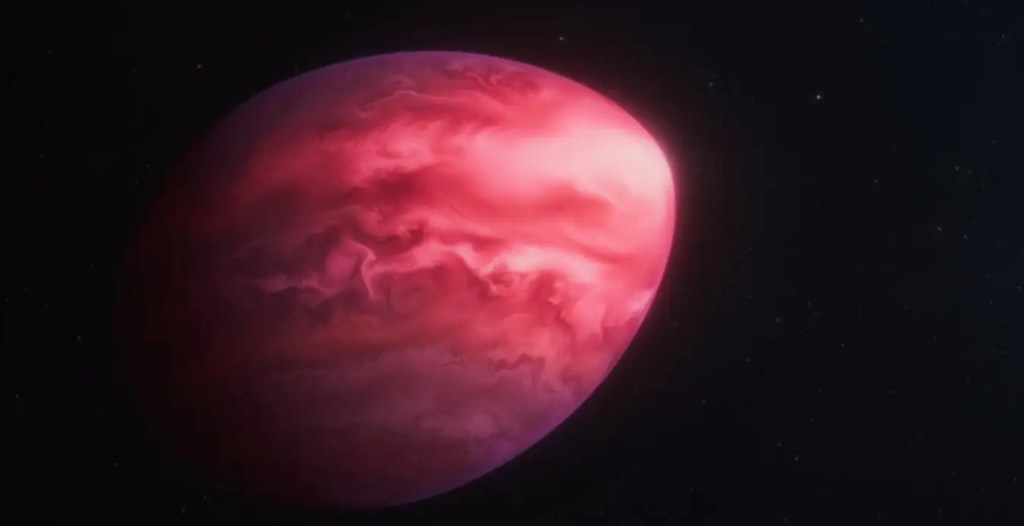
Astronomers have identified a planet that challenges existing theories of planet formation. The celestial body, designated PSR J2322-2650b, is roughly the size of Jupiter but exhibits a strikingly elongated shape, resembling a lemon. It orbits a pulsar, the dense remnant of a collapsed star, completing a full revolution every 7.8 hours. This proximity to its host pulsar subjects the planet to intense radiation, raising atmospheric temperatures to approximately 3,700 degrees Fahrenheit on the dayside, while the nightside cools to around 1,200 degrees Fahrenheit.
Unprecedented Atmospheric Composition
The planet’s atmosphere is rich in carbon, defying expectations set by current models. Researchers utilizing the James Webb Space Telescope analyzed the planet throughout its orbit to study how light passed through its atmosphere. Surprisingly, they found a spectrum dominated by carbon-based molecules, specifically chains known as C2 and C3, while typical elements like oxygen and nitrogen were either scarce or absent.
Michael Zhang, the lead author of the study, remarked, “The planet orbits a star that’s completely bizarre—the mass of the Sun, but the size of a city. This is a new type of planet atmosphere that nobody has ever seen before.” The findings reveal an extreme carbon-to-oxygen ratio exceeding 100 to 1, and a carbon-to-nitrogen ratio surpassing 10,000 to 1. These numbers are unprecedented, as no known planet around a typical star comes close to these levels, nor do existing theories concerning planets formed around pulsars account for such an atmosphere.
Challenges to Existing Theories
Planets like PSR J2322-2650b are often referred to as “black widow” systems. In these cases, a pulsar gradually strips material from a companion star, ultimately resulting in a dense remnant. This process typically leads to a mix of elements, rather than the extreme carbon composition observed in PSR J2322-2650b. The research team explored several hypotheses, such as unusual stellar chemistry or carbon-rich dust, but none fully explained the findings.
Moreover, the heating dynamics of the planet differ from those of typical hot Jupiters. Gamma rays penetrate deeper into the atmosphere, creating wind patterns that shift heat westward, contrary to the expected direct escape from the pulsar. This results in the hottest region of the atmosphere not aligning with traditional models.
As it stands, PSR J2322-2650b poses significant questions regarding planetary formation and composition. The James Webb Space Telescope has confirmed the planet’s unique characteristics, but the mystery of how it came to exist remains unresolved, prompting further investigation into this unusual celestial body.