South Korea’s ambitious initiative to bolster critical mineral resource security is confronting a significant workforce challenge. Mining companies are struggling to recruit adequate labor, and government-supported training programs are nearing conclusion, according to industry officials and academic experts.
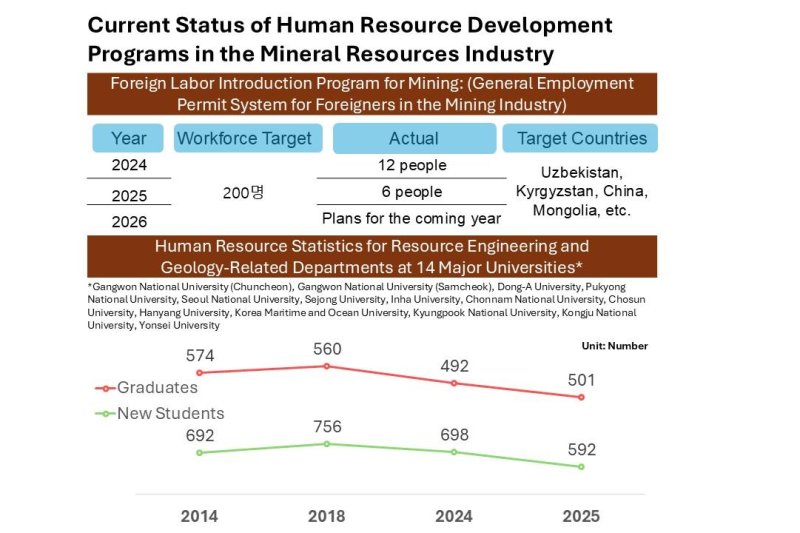
The Korea Mine Rehabilitation and Mining Industry Corporation reported that a project aimed at introducing foreign workers into the mining sector yielded only six hires this year, marking just 3% of its target of 200. This figure is a decline from the previous year and brings the total performance over two years to a mere 4.5% of the combined goal. The initiative was launched in response to worsening labor shortages within the mining industry.
Data from Statistics Korea highlighted a concerning trend: employment within the mining sector fell by 8.7% compared to the previous year. Industry representatives have indicated that attempts to integrate foreign workers have faced numerous obstacles. One official noted that permitting foreign workers to perform specific supporting roles related to explosives could help alleviate labor shortages, but such tasks remain prohibited due to past safety incidents at tunnel construction sites.
Practical challenges, including communication barriers, cultural differences, and skill gaps, have further complicated efforts to recruit foreign labor. The situation is exacerbated by the impending conclusion of domestic workforce development programs, which raises concerns about the future supply of engineers and technicians in the mining sector.
The government-funded training initiative, which operated from 2009 to 2019 with a total investment of 87.5 billion won (approximately $66 million), was suspended for two years before being resumed with reduced funding. Now, it is set to end, leading to fears of a diminishing talent pipeline. A mining industry official stated that a recent request for new project funding through the Ministry of Trade, Industry and Energy was not approved by the Finance Ministry.
While the official mentioned that training could potentially be pursued as a project under the Education Ministry if local demand arises, no regional governments currently have plans for workforce development. Universities that previously merged or closed resource engineering departments are also on alert, as support programs are nearing expiration. For instance, Kangwon National University is only admitting two students into its resource engineering major this year.
Professor Kim Jin-soo from Hanyang University emphasized that educational programs in resource development and mining have largely deteriorated, despite attempts to maintain training through industry coalitions and government initiatives. The ongoing shortage of skilled workers could heighten reliance on foreign technology and personnel, potentially undermining domestic knowledge accumulation.
Enrollment figures underscore the severity of the issue: 13 South Korean universities with resource engineering and geology departments reported a total of 592 students this year, a decrease of 106 from the previous year. The number of students in resource engineering has fallen to 422, dropping below 500 for the first time in 12 years.
In an attempt to address these challenges, the South Korean government enacted a special law on national resource security this year and incorporated critical minerals into the National Growth Fund support list. Experts argue that workforce development must be seen as integral to the industrial ecosystem, advocating for a coordinated approach where government and industry collaborate to identify demand, expand clusters, and train workers accordingly.
Professor Nam Kwang-soo from Sangji University stressed the importance of personnel with field experience and specialized skills for overseas resource development, urging the government to play a proactive role in establishing a robust talent pipeline.