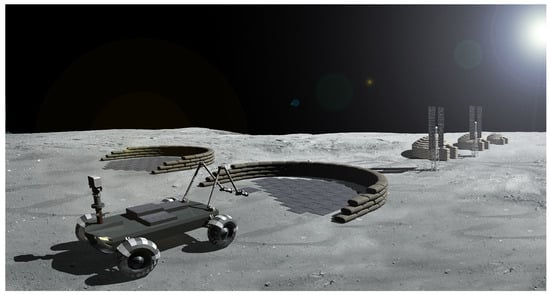
Engineers at Purdue University have developed a groundbreaking approach to constructing reusable lunar launch pads using local materials. In a paper published in Acta Astronautica, lead researcher Shirley Dyke and her team explored the feasibility of using lunar regolith to create these essential structures. With the rising costs associated with transporting materials from Earth, leveraging lunar resources is imperative for future space missions.
The concept of a landing pad may seem unnecessary, as heavy-capacity rockets like SpaceX’s Starship could theoretically land on any flat surface. However, the dangers posed by rocket plume interactions with the lunar surface demand a more structured approach. Without a dedicated landing pad, the force from retrograde rockets could displace rocks and dust, potentially damaging both the rocket and nearby structures, such as future lunar bases.
Understanding Lunar Regolith for Construction
Current knowledge about lunar regolith and its properties is limited. Traditional construction methods employed on Earth, such as using concrete, are not feasible for the Moon due to the exorbitant costs of transporting materials. Dr. Dyke emphasizes the need for in-situ testing of lunar materials to ascertain their mechanical properties, particularly the strength of sintered regolith—an essential component for creating a cohesive landing pad.
Simulants, which are materials designed to mimic lunar regolith, have been utilized for preliminary testing. Yet, Dr. Dyke notes, “simulants are called simulants for a reason.” Actual lunar conditions can significantly alter material behavior, making it crucial to conduct tests directly on the Moon.
The design of the landing pad hinges on two main factors: its mechanical properties under force and its thermal properties. While much of the material behavior remains unknown, the team has estimated structural characteristics based on existing literature. Initial theories suggest that sintered regolith may exhibit brittleness and be weaker when subjected to tension rather than compression.
Addressing Thermal Challenges
Thermal behavior also poses significant challenges. The temperature fluctuations on the Moon, which vary dramatically throughout its 28-day day/night cycle, can cause expansion and contraction of the landing pad. This thermal stress, compounded by the friction of loose regolith beneath the pad, creates uncertainties in the design process.
To mitigate potential issues, Dr. Dyke’s team recommends constructing the landing pad to a thickness of approximately 1/3 of a meter (or 14 inches). While one might consider increasing the thickness to enhance durability, Dr. Dyke points out that excessive depth may actually lead to quicker fractures under thermal stress.
One anticipated failure mode is spalling, where chips of the pad break off due to thermal expansion and contraction. Although the pad can maintain structural integrity, repeated rocket landings may degrade its capacity to support heavy loads over time.
The most critical concern, however, is the potential for the pad to fracture. This can occur due to thermal stress, spalling, or an improperly angled landing. Given the myriad uncertainties in the design process, Dr. Dyke and her colleagues advocate for a robust plan involving in-situ testing on the Moon.
Initial lunar missions are likely to focus on collecting data regarding the materials intended for the landing pad rather than immediately constructing it. Equipped with instruments to monitor deformation and thermal responses, these missions could provide invaluable insights that inform future designs.
Robotic technologies are expected to play a pivotal role in both the construction and maintenance of the lunar landing pad. The challenges of human labor in a space suit, particularly in the Moon’s harsh environment, underscore the necessity of utilizing autonomous or teleoperated systems for this complex task.
As NASA continues its efforts to return astronauts to the Moon, the groundwork laid by Dr. Dyke’s research may prove essential for future lunar exploration. Even in the absence of extensive data, the iterative testing and design process proposed in the paper could ultimately yield a safe and effective landing pad, facilitating humanity’s next steps toward interplanetary travel.