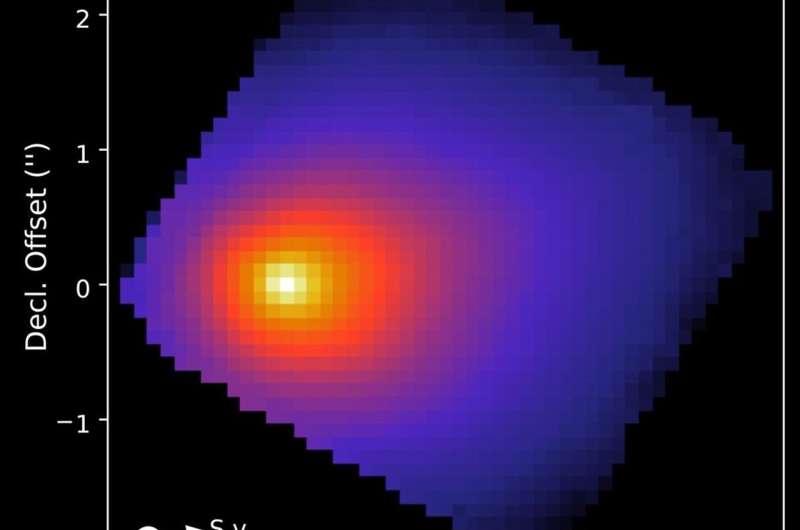
NASA’s Europa Clipper spacecraft has made a significant scientific breakthrough by capturing unique ultraviolet observations of the interstellar comet 3I/ATLAS. This observation, recorded on December 20, 2025, occurred during a critical time when Earth-based telescopes were unable to view the comet due to its proximity to the Sun. The mission has provided an unprecedented perspective on the comet’s dust and plasma tails, revealing vital information about its composition and activity after its closest approach to the Sun.
The Southwest Research Institute (SwRI) led the Ultraviolet Spectrograph (UVS) instrument aboard the Europa Clipper, which launched in 2024 and is expected to reach the Jovian system by 2030. This advanced instrument was able to observe 3I/ATLAS when visibility from both Mars and Earth was severely limited. “We’re excited that this opportunity to view another target on the way to Jupiter was completely unexpected,” stated Dr. Kurt Retherford, the principal investigator for Europa-UVS.
The timing of the observations was crucial. Less than a week after 3I/ATLAS was discovered, analysts at NASA’s Jet Propulsion Laboratory (JPL) calculated its trajectory, allowing the Europa Clipper team to plan observations in November. This approach provided a much-needed gap in data collection, linking earlier Mars-based observations from late September with later opportunities from Earth.
The unique position of the Europa Clipper allowed scientists to capture a downstream view of the comet’s two primary tails: a dust tail trailing behind and a plasma tail that extends away from the Sun. This perspective, looking from “behind” the tails toward the comet’s nucleus, is rarely achieved and offers valuable insights into the comet’s behavior.
In addition to these observations, the SwRI-led UVS instrument aboard the European Space Agency’s Jupiter Icy Moons Explorer (JUICE) will provide an anti-sunward view, allowing scientists to compare different angles of data collected during this same period. “We’re hopeful that this new view, along with observations from Earth-based assets and other spacecraft, will help us to piece together a more complete understanding of the tails’ geometries,” said Dr. Thomas Greathouse, co-deputy principal investigator of Europa-UVS.
The findings from the Europa Clipper have identified signatures of oxygen, hydrogen, and dust, indicating that 3I/ATLAS experienced significant outgassing activity shortly after its closest approach to the Sun. “Europa-UVS is particularly adept at measuring fundamental transitions from atoms and molecules,” Retherford explained. “We can see gases come off the comet, and water molecules break apart into hydrogen and oxygen atoms.”
These measurements provide a detailed view of the comet’s composition and the dynamics occurring as it travels through space. Understanding the gases emitted can shed light on the comet’s origin and evolution from its formation around another star to its entry into our solar system. “What are the chemical processes at play, and how can we unravel the comet’s origin in its own star system? Were those processes similar to how we believe our solar system formed? Those are big questions,” remarked Dr. Tracy Becker, co-deputy principal investigator of Europa-UVS.
The Europa Clipper mission, managed by JPL for NASA’s Science Mission Directorate in Washington, D.C., represents a significant step in our understanding of interstellar objects and the formation of comets. The data collected will not only advance scientific knowledge but also enhance our comprehension of the broader cosmic environment.