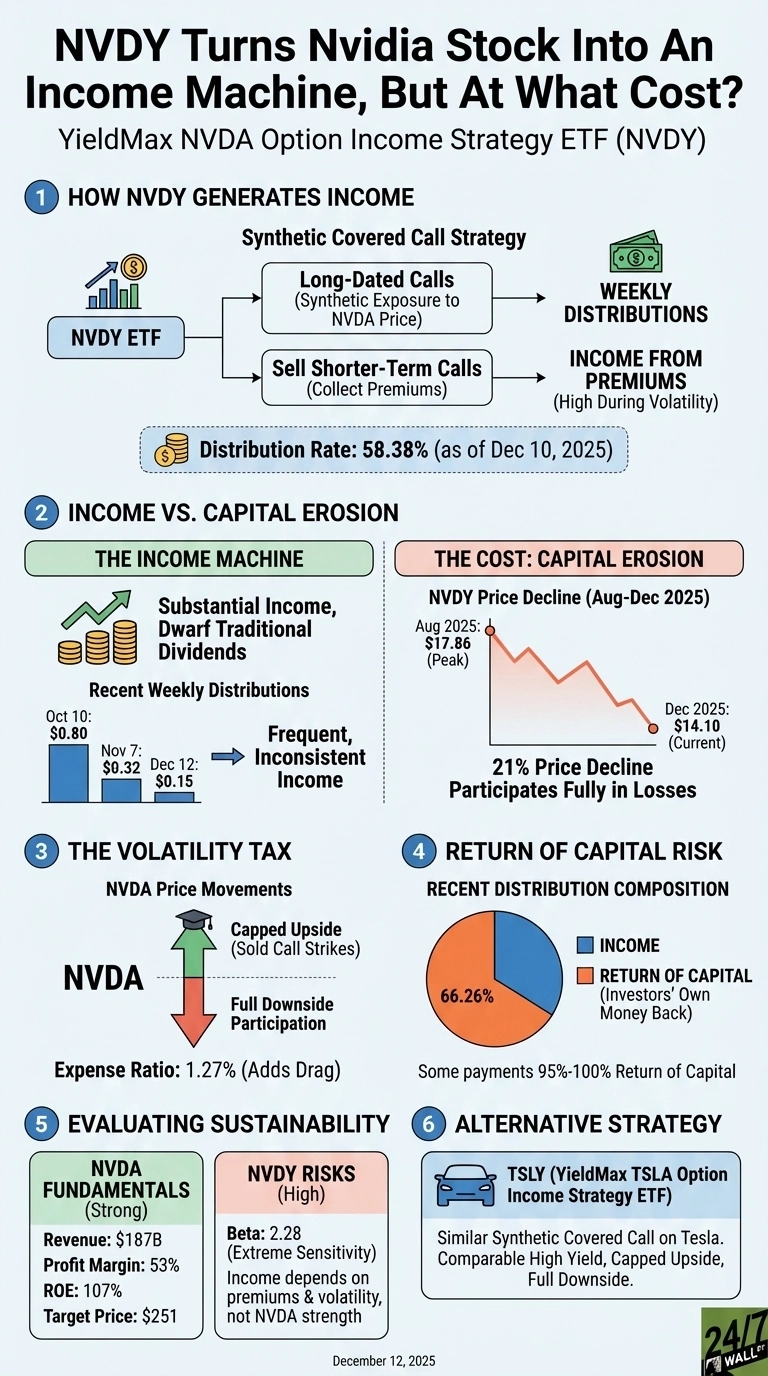
YieldMax NVDA Option Income Strategy ETF (NYSEARCA: NVDY) is drawing attention from income-focused investors with its impressive distribution rate of 58.38% as of December 10, 2025. However, a closer look at the fund reveals a troubling trend: a significant portion of its recent distributions is being classified as a return of capital rather than actual investment gains. This raises important questions about the sustainability and reliability of the income investors are receiving.
From August to December, NVDY experienced a decline of 21%, falling from $17.86 to $14.10. Despite distributing approximately $11.91 per share over the past year, the fund’s performance highlights a critical issue: are investors truly benefiting from income, or are they merely receiving their own capital back in installments?
Understanding NVDY’s Income Generation Strategy
NVDY generates income through a synthetic covered call strategy, which involves selling call options on shares of Nvidia (NASDAQ: NVDA) without owning the stock directly. By utilizing long-dated call options to create synthetic exposure and selling shorter-term calls to collect premiums, the fund aims to capitalize on market volatility. This strategy can yield substantial income when there is high market fluctuation, as option premiums tend to rise during these periods.
Recent distribution patterns illustrate this approach. For example, NVDY paid $0.15 per share on December 12, following smaller payments of $0.16 and $0.15 in the previous weeks. In contrast, the fund made larger payments of $0.80 on October 10 and $0.32 on November 7. The transition to weekly distributions in October 2025 has provided investors with more frequent, albeit inconsistent, income.
Challenges of Income Sustainability
Despite the attractive distribution rates, NVDY’s income sustainability is heavily contingent on Nvidia’s stock volatility and the premiums from selling call options. Nvidia continues to demonstrate strong fundamentals, boasting $187 billion in trailing revenue, 53% profit margins, and a 107% return on equity. Furthermore, the company holds a dominant position in the AI accelerator market and enjoys significant pricing power across various sectors, including data centers and gaming.
Nevertheless, NVDY holders do not reap the same benefits as equity investors in Nvidia. The fluctuations in the fund’s distributions are directly linked to the volatility of option premiums, which can rise during market swings but provide no guaranteed income floor. The fund’s beta of 2.28 indicates high sensitivity to price movements, creating both the potential for premium collection and the risk of capital loss.
A particularly concerning statistic is that 66.26% of the most recent distribution was classified as a return of capital. In some instances, payments consisted of up to 100% return of capital, highlighting the reality that investors are receiving their own money back rather than genuine investment gains.
Alternative strategies, such as the YieldMax TSLA Option Income Strategy ETF (NYSEARCA: TSLY), offer a similar approach using Tesla as the underlying asset. TSLY also generates weekly income through options while facing the same trade-offs of capped upside potential and full downside exposure.
As investors navigate the complex landscape of income-generating funds, understanding the nuances of these strategies is vital. While NVDY offers an attractive yield, the reality of capital erosion and the nature of the returns raises crucial considerations for long-term investment strategies.
In an age where many investors are focused on asset growth, the importance of reliable income streams cannot be overstated. The Definitive Guide to Retirement Income aims to assist investors in effectively transitioning from wealth accumulation to sustainable retirement income, offering valuable insights and strategies to ensure financial security in later years.