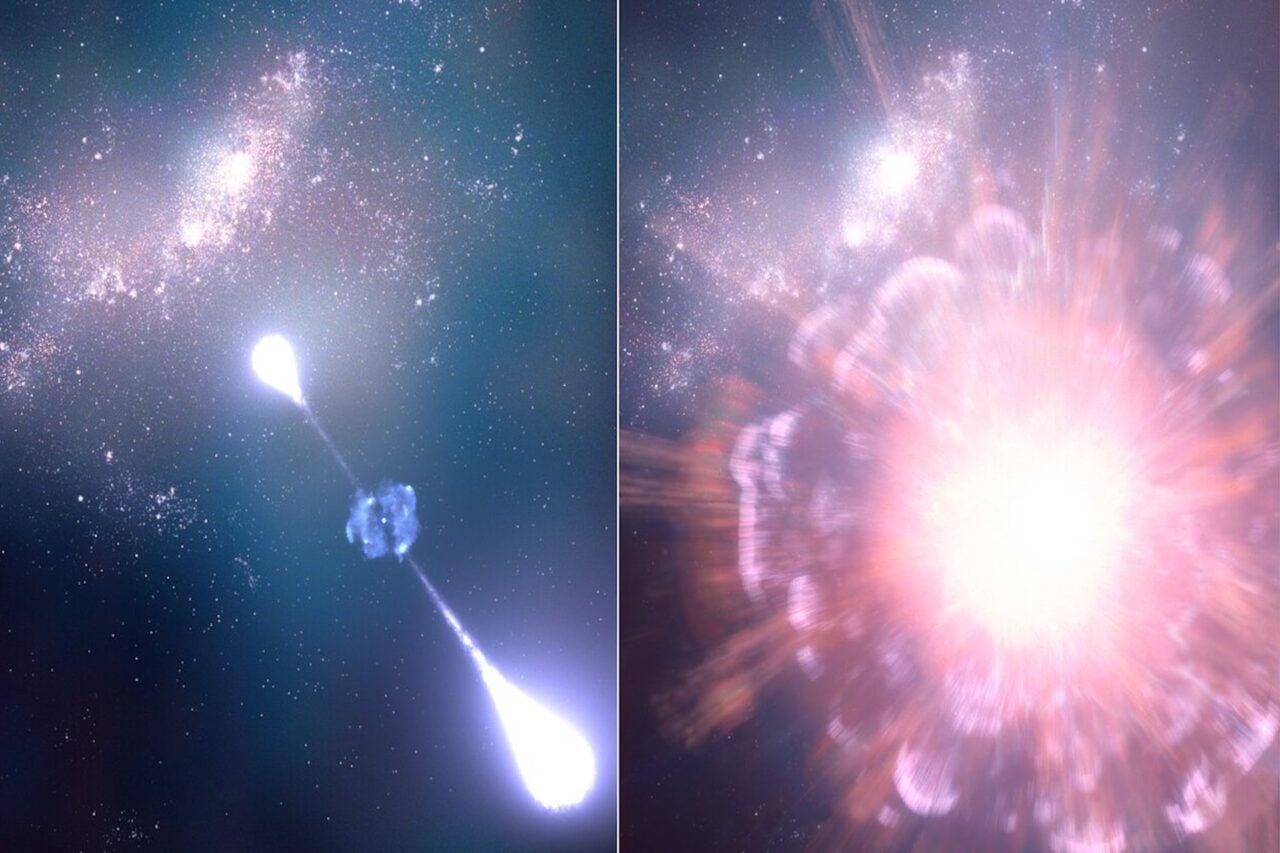
A remarkable scientific breakthrough has occurred as the James Webb Space Telescope identified the oldest supernova ever observed, dating back to a time when the universe was just 730 million years old. This discovery sheds light on the cosmic events that unfolded shortly after the Big Bang, providing insights into the early universe and the life cycles of stars.
The supernova was traced to a gamma-ray burst detected earlier this year on March 14, 2023, by the SVOM mission (Space-based multi-band astronomical Variable Objects Monitor). Within hours, teams around the world used various telescopes to pinpoint the event’s location and timeline, confirming its significance in the broader context of cosmic history. According to Andrew Levan, an astrophysics professor at Radboud University in the Netherlands and lead author of a paper published in Astronomy and Astrophysics Letters, “Only Webb could directly show that this light is from a supernova.”
The gamma-ray burst that led to this discovery lasted approximately 10 seconds, suggesting it was likely caused by the explosive death of a massive star. This is significant when compared to typical gamma-ray bursts, which usually last only a few seconds. The Webb telescope’s observations, conducted on July 1, 2023, occurred after the initial detection, allowing the supernova’s brightness to increase, making it easier to observe.
Astronomers have long believed that supernovae from the early universe would differ significantly from those observed more recently due to the lower presence of heavy elements in early stars. Surprisingly, when the team compared this ancient supernova to more recent ones, they found striking similarities. Nial Tanvir, a professor at the University of Leicester and co-author of the paper, stated, “We went in with open minds, and lo and behold, Webb showed that this supernova looks exactly like modern supernovae.”
This discovery not only sets a new record for the oldest stellar explosion but also enhances understanding of how galaxies evolved over time. The team plans to utilize the Webb telescope for further observations, specifically targeting the afterglows of distant gamma-ray bursts. “That glow will help Webb see more and give us a ‘fingerprint’ of the galaxy,” Levan added.
Overall, this groundbreaking observation opens new avenues for research, allowing astronomers to explore the origins of stars and the formation of galaxies in the early universe. As the Webb telescope continues its mission, it promises to unravel even more mysteries of our cosmos.