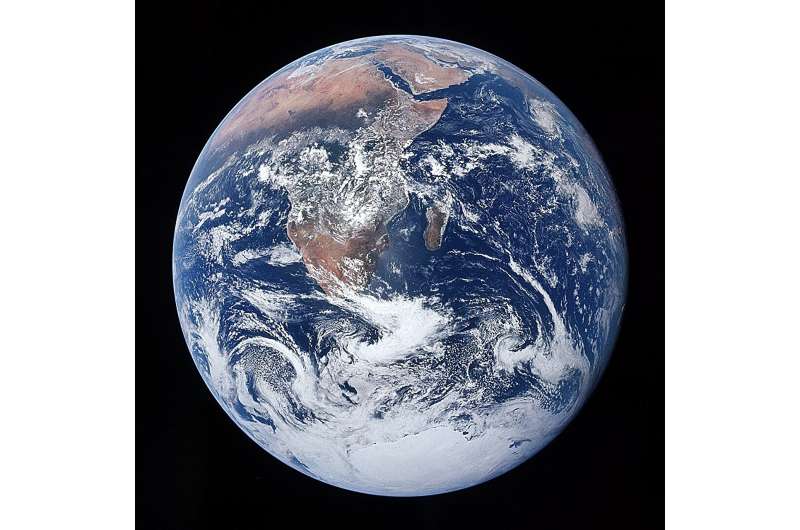
Research has unveiled that Mars plays a significant role in shaping Earth’s climate, according to a recent study led by Stephen Kane. Published on December 10, 2025 in the arXiv preprint server, the findings indicate that Mars, despite its smaller size compared to gas giants like Jupiter and Venus, exerts a surprisingly strong gravitational influence on Earth’s climate patterns through what are known as Milankovitch cycles.
Earth’s climate has oscillated between ice ages and warmer periods for millions of years, primarily due to subtle changes in its orbit and axial tilt. These variations occur because Earth is not alone in its orbit around the sun. The gravitational forces from other planets, particularly those in our solar system, play a crucial role in altering Earth’s orbital path.
Kane and his team conducted extensive computer simulations, adjusting Mars’s mass from zero to ten times its current value. This research aimed to observe how these variations impacted Earth’s orbital changes over millions of years. The results established Mars as a pivotal contributor to the dynamics of Earth’s climate.
Climate Cycles and Mars’s Gravitational Impact
Among the key findings, the team discovered that the most stable feature across all simulations was the 405,000-year eccentricity cycle, influenced by the gravitational interactions between Venus and Jupiter. This cycle provides a constant rhythm underlying Earth’s climate variations.
In contrast, the shorter cycles of approximately 100,000 years, which correlate with transitions into ice ages, are highly dependent on Mars. As simulations showed an increase in Mars’s mass, these cycles lengthened and intensified, indicating a stronger gravitational coupling among the inner planets. Notably, when Mars’s mass was diminished to zero in the models, an essential climate pattern vanished entirely.
The 2.4 million-year “grand cycle”, responsible for long-term climate fluctuations, exists solely because Mars possesses sufficient mass to create the necessary gravitational resonance. This cycle, linked to the slow rotation of both Earth and Mars’s orbits, significantly affects the amount of sunlight Earth receives over extended periods.
Broader Implications for Habitability
The implications of this research extend beyond our planet. Understanding Mars’s influence helps scientists assess the habitability of Earth-like exoplanets. A terrestrial planet with a large neighboring planet in the right orbital configuration may experience climate variations that facilitate life by preventing extreme conditions such as runaway freezing.
Kane’s findings emphasize that Earth’s Milankovitch cycles are not solely a result of interactions with the sun. They are influenced by the entire planetary environment, with Mars playing an unexpectedly vital role in shaping our climate. This research enhances our understanding of planetary systems and could inform future studies on climate dynamics in other solar systems.
Further details can be found in the study titled “The Dependence of Earth Milankovitch Cycles on Martian Mass,” authored by Stephen R. Kane and colleagues, available on the arXiv preprint server.