Detailed imaging of nova explosions has revealed unexpected complexities in these explosive stellar events. Astronomers have documented intricate processes during thermonuclear eruptions on white dwarfs in binary systems, showcasing multiple ejections and the formation of high-energy gamma-ray emissions. This research offers significant insights into the mechanisms driving these phenomena.
Nova explosions occur when matter accumulates on the surface of a white dwarf, a type of stellar remnant formed after a star has exhausted its nuclear fuel. As hydrogen from a companion star is drawn onto the white dwarf, it heats up until a runaway thermonuclear explosion occurs. While some novae can lead to the destruction of the white dwarf, classified as Type Ia supernovae, many result in the ejection of material into space without completely obliterating the star.
New findings published in the journal Nature Astronomy highlight the complexity of these explosions based on observations of two specific novae, V1674 Her and V1405 Cas. Lead author Elias Aydi from Texas Tech University noted, “These observations allow us to watch a stellar explosion in real time, something that is very complicated and has long been thought to be extremely challenging.”
Complex Mechanisms of Nova Explosions
The study indicates that nova explosions are not simple events but involve intricate processes. The research suggests that while most of the accreted material is expelled during these eruptions, the exact mechanisms behind this impulsive ejection—whether through multiple outflows or prolonged winds—remain uncertain. The team has detected gamma-ray emissions from over 20 novae, positioning them as laboratories for studying shock physics and particle acceleration.
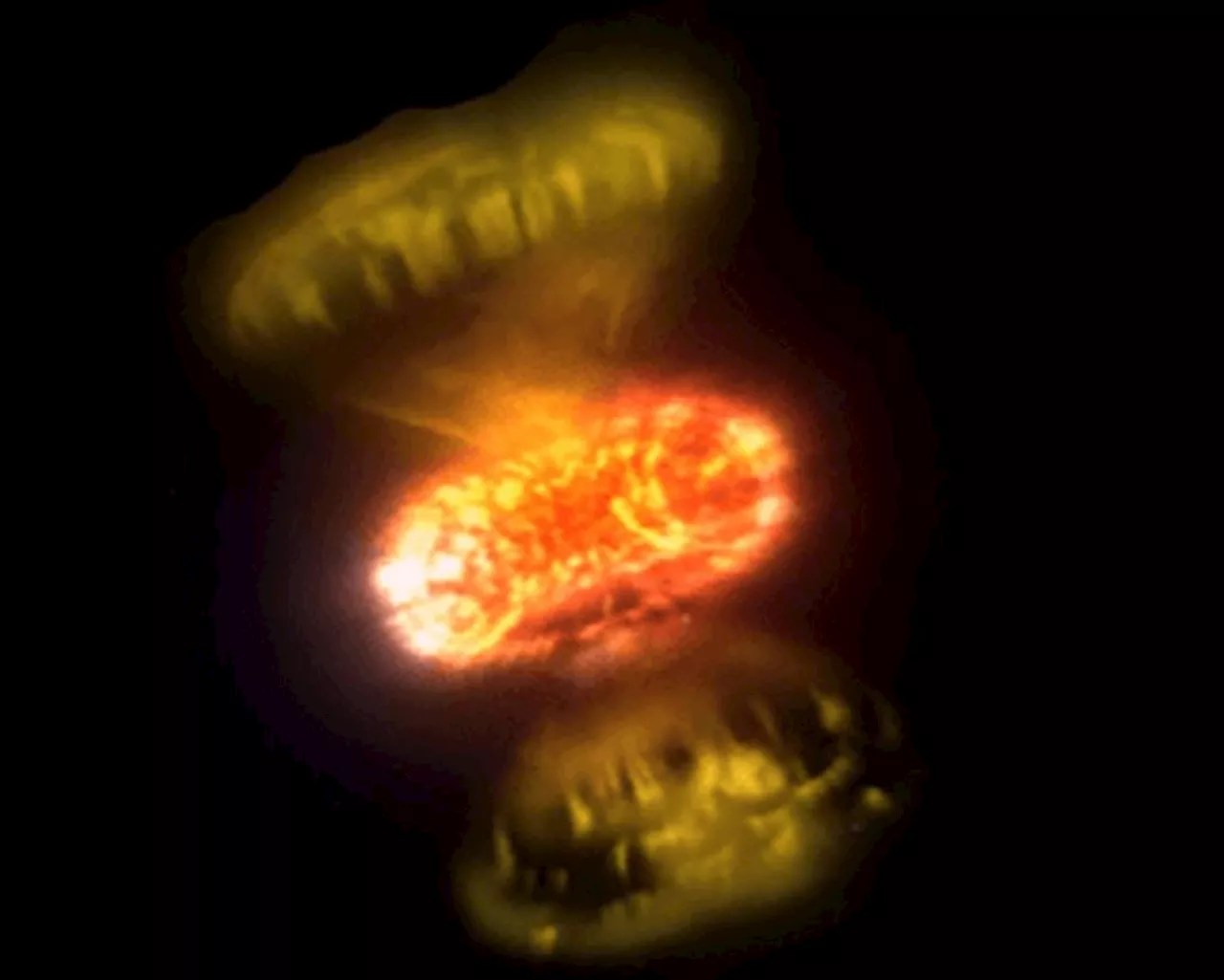
For instance, V1674 Her is categorized as a fast nova, with images taken just 2-3 days after the explosion revealing two perpendicular outflows. This suggests multiple interacting ejections occurring in rapid succession. In contrast, V1405 Cas, identified as a slow nova, displayed delayed ejection of material that was first noticeable 50 days post-eruption. The subsequent ejections led to new shock formations and additional gamma-ray emissions.
“Instead of seeing just a simple flash of light, we’re now uncovering the true complexity of how these explosions unfold. It’s like going from a grainy black-and-white photo to high-definition video,” Aydi added.
Advanced Techniques and Future Research Directions
The research utilized two advanced observational techniques: interferometry and spectrometry. The CHARA Array at Georgia State University provided critical interferometric data, which allowed astronomers to uncover fine details of the explosions. Meanwhile, spectrometry from other observatories helped identify new chemical signatures in the ejected material.
Co-author John Monnier, a professor of astronomy at the University of Michigan, emphasized the significance of these findings: “The fact that we can now watch stars explode and immediately see the structure of the material being blasted into space is remarkable. It opens a new window into some of the most dramatic events in the universe.”
The researchers believe that understanding the complexities of nova explosions could lead to broader insights into stellar evolution and the dynamics of binary star systems. As noted by Professor Laura Chomiuk from Michigan State University, “Novae are more than fireworks in our galaxy—they are laboratories for extreme physics.”
Aydi concluded, “With more observations like these, we can finally start answering big questions about how stars live, die, and affect their surroundings. Novae, once seen as simple explosions, are turning out to be much richer and more fascinating than we imagined.”
This research marks a significant advancement in our understanding of novae, highlighting the need for further observations to confirm whether the delayed ejection phenomena are common across other nova events. Future studies using interferometers and other optical instruments will deepen our knowledge of these explosive stellar phenomena and their impact on the cosmos.