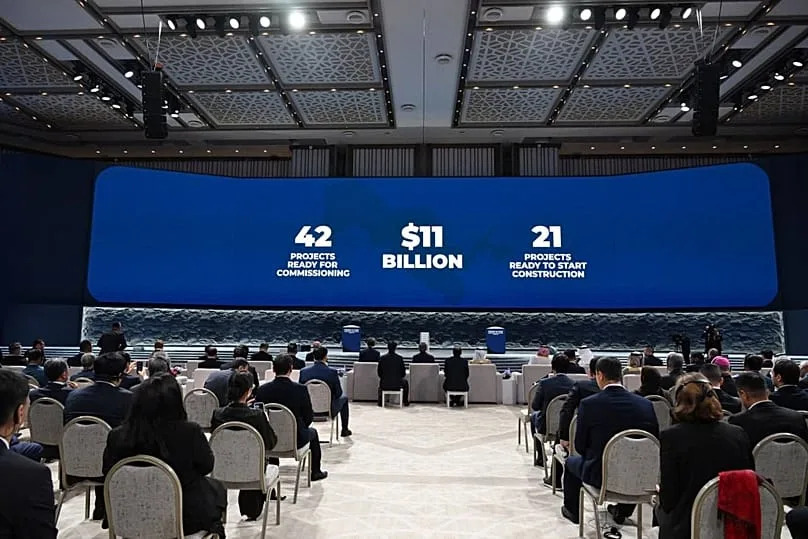
Uzbekistan is embarking on an ambitious green energy initiative, announcing plans to invest €9.46 billion in 42 renewable energy projects. By 2026, the government aims for every household in the country to rely solely on clean electricity. The announcement was made by President Shavkat Mirziyoyev during the forum titled “Powering the Future: Sustainable Energy for New Uzbekistan,” where numerous renewable energy and grid projects were unveiled.
Major Investments and Infrastructure Developments
The initiative includes the construction of generation facilities, energy-storage systems, substations, and high-voltage networks. Among the developments are 16 new solar, wind, thermal, and hydropower plants, which will collectively generate 3,500 megawatts of energy. These facilities will be strategically located across various regions of Uzbekistan, incorporating both public and private investments.
A significant component of the plan is the introduction of 10 utility-scale energy storage systems that will provide 1,245 megawatts of capacity. According to the Ministry of Energy, these systems will enable the injection of up to 1.5 billion kilowatt-hours of additional electricity into the grid during peak periods, thereby stabilising supply. To complement these efforts, Uzbekistan is also commissioning 11 substations and constructing 420 kilometres of high-voltage transmission lines.
“We have set two major objectives as our main priorities in this direction,” Mirziyoyev stated. “The first is to ensure a reliable and uninterrupted energy supply for all sectors and regions. The second is to achieve this goal through modern, environmentally friendly, and renewable alternative energy sources.”
Foreign Investment and Collaborative Efforts
The forum attracted government officials, international companies, and financial institutions, highlighting Uzbekistan’s growing appeal as an investment destination. In recent years, the country has secured approximately €30 billion for its energy sector. Since 2017, Uzbekistan has added 9,000 megawatts of new capacity, increasing total electricity generation from 60 billion kilowatt-hours to an estimated 85 billion kilowatt-hours by 2024.
International companies, including Saudi Arabia’s ACWA Power, play a crucial role in these developments. Jon Zaidi, the Country Head for ACWA Power, noted, “Uzbekistan’s energy mix is becoming greener every year. This year alone we added more than 2,500 megawatts to the grid, and the Vision 2030 target of reaching 54% renewables is very important for us.”
Another key player, Voltalia from France, recently signed an agreement for a 200-megawatt hybrid project that combines wind generation and storage. Deputy CEO Yoni Ammar highlighted their plans for a 500-megawatt project named Turan, with construction expected to commence in 2026.
European companies are also contributing to conventional energy projects. Pierre-Paul Antheunissens, General Director of Electricite de France (EDF) Central Asia, mentioned that the company is building two major gas-fired power plants in collaboration with partners from Japan, Qatar, and Germany.
Environmental Impact and Future Goals
The expansion of renewable energy is not only about meeting electricity demands; it also aims to significantly reduce environmental impact. According to the Minister of Energy, Jurabek Mirzamakhmudov, the initiative will decrease natural gas consumption by nearly 7 billion cubic meters and prevent 11 million tons of harmful emissions. By 2030, Uzbekistan plans to increase its renewable energy capacity by more than 17,000 megawatts, raising the share of green energy in overall generation to 54%.
Realising this target will involve constructing 6,000 kilometres of high-voltage networks, with 1,000 kilometres scheduled for development next year. At the recent COP-30 climate conference in Brazil, Uzbekistan reported progress on the iCraft initiative, developed in partnership with the World Bank, which aims for 23 million tons of verified greenhouse-gas reductions. The initiative has also enabled the country to establish a carbon-credit trading system, with 17 domestic industrial companies adopting international green-energy certification.
Expanding Public-Private Partnerships
Uzbekistan is broadening its public-private partnerships beyond energy generation to include energy distribution. Earlier this year, the Samarkand regional grid was transferred to private management under an agreement with Aksa Elektrik from Turkey. This partnership is expected to enhance operational management, modernisation efforts, and reduce losses, potentially saving approximately €17.2 million annually.
The government plans to offer several more regional grids to investors in the coming years as part of its strategy to improve efficiency and management practices. Additionally, small-scale renewable initiatives are being promoted, including a new programme to install 107 megawatts of rooftop and micro-solar plants across 300 mahallas, or neighbourhoods. This initiative aims to provide green energy to 30,000 low-income families who will also have the opportunity to sell excess electricity back to the grid.
Investments in small hydropower are also on the rise. This year, 40 micro-hydro plants with a total capacity of 40 megawatts generated 120 million kilowatt-hours of electricity, with plans for an additional 65 megawatts of micro-hydropower capacity next year, which is expected to improve electricity supply for 80,000 households.
Uzbekistan is enhancing energy cooperation with neighbouring countries, planning to finance the Kambarata-1 hydropower project with Kyrgyzstan and Kazakhstan to strengthen the region’s water-energy system. Additionally, work is ongoing on the Green Energy Corridor, which aims to facilitate the export of Central Asian electricity to Europe, involving collaboration with Azerbaijan and Kazakhstan.
Through these comprehensive initiatives, Uzbekistan is positioning itself as a leader in renewable energy, aiming for sustainable growth while addressing environmental challenges.