
Advancements in the understanding of copper chalcogenides could significantly enhance the efficiency of carbon dioxide (CO₂) conversion processes. Researchers at National Taiwan University have unveiled a charge-redistribution mechanism that explains the exceptional ability of these compounds to selectively convert CO₂ into formate. This breakthrough, published on December 3, 2025, in the journal Nature Communications, could reshape the approach to designing catalysts for industrial applications.
For many years, scientists have been intrigued by the unique properties of copper chalcogenides. These materials exhibit a remarkable selectivity for transforming CO₂ into formate, a process that is typically more associated with p-block metals like tin or bismuth. This is particularly surprising given that copper (Cu), a transition metal, usually lacks significant intrinsic selectivity for products. The origins of this distinctive behavior have remained unclear, posing a challenge for researchers in the field.
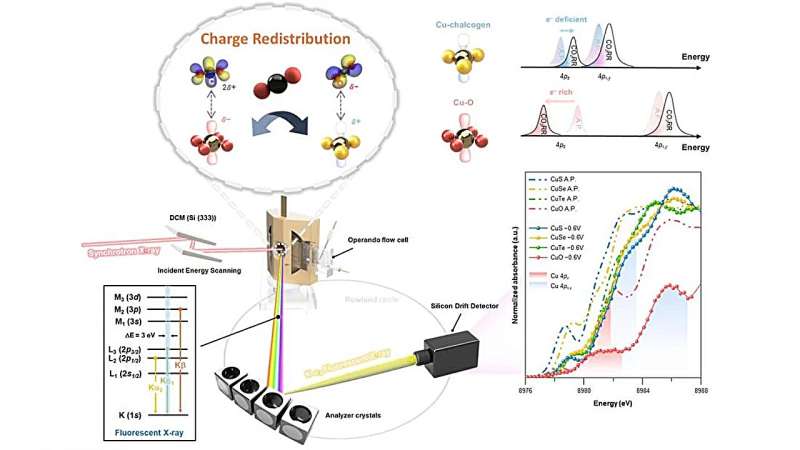
The research team led by distinguished professor of chemistry Hao Ming Chen utilized a range of operando synchrotron-based X-ray spectroscopic techniques. Their innovative approach allowed them to capture direct spectroscopic evidence, shedding light on the mechanisms behind the catalytic processes. They discovered that chalcogenide anions play a crucial role in stabilizing the catalytic structure, preventing the over-reduction of cuprous (Cu+) species to metallic Cu0. This stabilization maintains an electronic configuration that favors the formation of mono-carbon intermediates, such as carbon monoxide (CO) and formate.
The findings indicate that these chalcogenide anions also induce a charge-redistribution process within the Cu+ sites. This dynamic stabilization of O-bound formate intermediates effectively guides the CO₂ reduction pathway towards formate production while suppressing competing pathways that lead to CO and multi-carbon products. As a result, Cu-chalcogenide catalysts achieve near-complete selectivity for formate.
The research highlighted the performance of the optimal CuS catalyst, which demonstrated an impressive 90% faradaic efficiency for formate at -0.6 V, with a formate partial current exceeding an ampere-scale. This level of efficiency signifies promising scalability for potential industrial applications, marking a significant step forward in catalytic technology.
Professor Chen commented on the implications of the study, stating, “Copper chalcogenides have fascinated researchers for decades because of their enhanced formate selectivity, but the true origin of this behavior was never fully understood. Our study reveals that charge-redistribution dynamics redefine the fundamental principles governing CO₂ reduction selectivity and offer a new design strategy for tuning catalyst electronic structure via chalcogen modification.”
This research not only addresses a long-standing question in the field of catalysis but also opens new avenues for the rational electronic modulation of electrocatalysts. The understanding of charge redistribution dynamics could lead to the development of more efficient and selective catalysts, crucial for advancing sustainable carbon capture and conversion technologies.
The study, titled “Charge redistribution dynamics in chalcogenide-stabilized cuprous electrocatalysts unleash ampere-scale partial current toward formate production,” is authored by Feng-Ze Tian and colleagues, and provides a detailed examination of the underlying mechanisms at play. This work is anticipated to pave the way for future innovations in the development of effective electrocatalytic processes, contributing to global efforts in reducing carbon emissions and combating climate change.


